
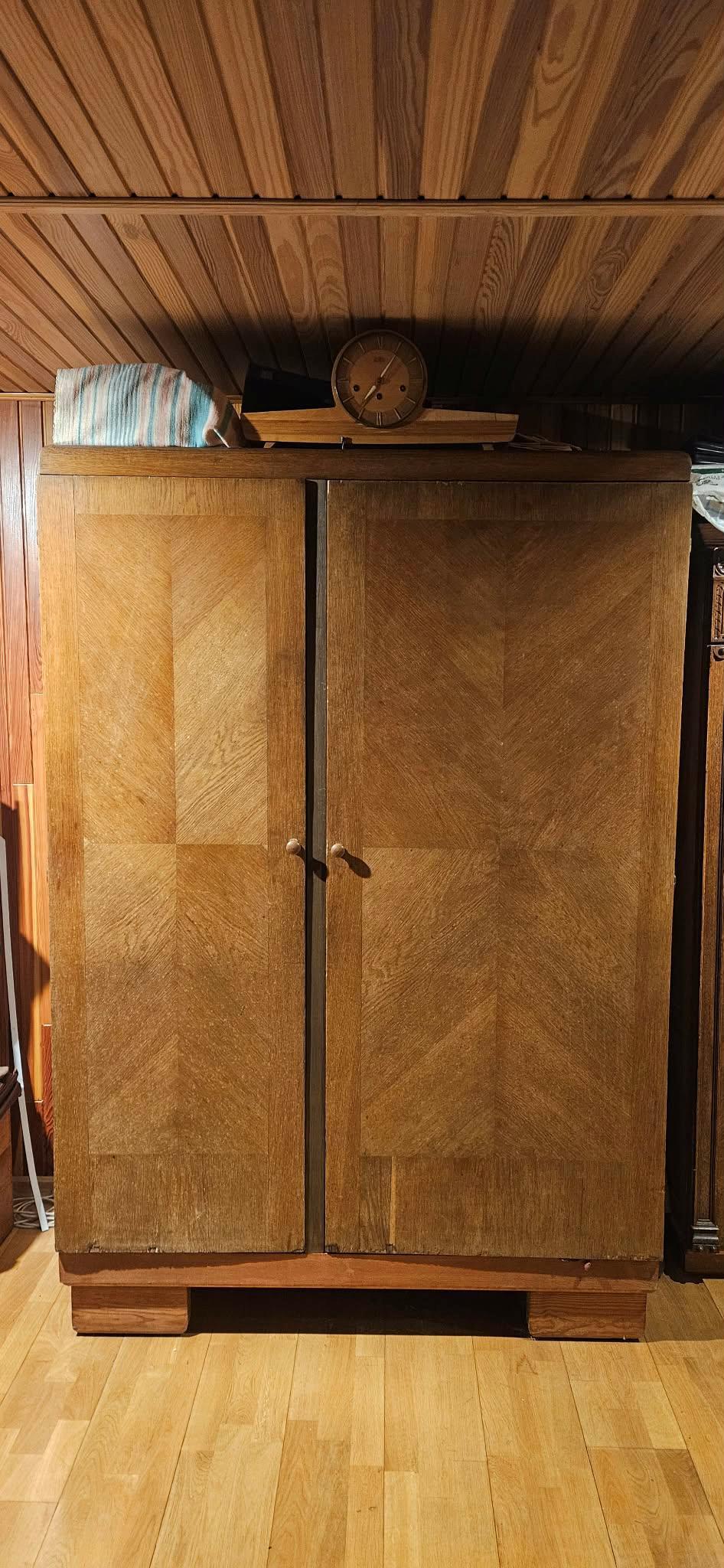
The two-hundred-year-old oak wardrobe
Most of my friends treat old furniture like useless rubbish that is worth throwing away during the first renovation to replace them with products from chain stores made of chipboard. In my home, the approach to furniture is completely different. In the middle of my great-grandmother's living room there is a two-hundred-year-old oak wardrobe for linens. It may not be modern, but for my family it is a kind of relic of our ancestors. This object that has survived so many changes and was used by many generations of my family.
The story of this piece of furniture begins in a manor house in Mazovia, near Płock. It belonged to my great-grandmother's great-grandfather and was a typical noble residence, a stronghold of Polish identity during the difficult times of the Russian partition. Today, there is no trace left of that place. During World War II, the manor was completely looted and then burned down by Russian troops. This wardrobe is probably the only material relic we have left from that world. The wardrobe left the manor long before the First World War. It was a gift for the mother of my great-grandmother, Róża. When my great-grandmother, newly married women, moved from those areas to Warsaw in the interwar period, she took it with her as the only part of the family property. My great-grandmother moved with the thought of a new, better life in the capital. She hoped for peace and new opportunities provided by her passed school exams and the work of her husband, my great-grandfather Władek, in the State Forests structures. The worst time came in September 1939. The situation of my great-grandparents quickly changed. My great-grandfather Władek, working just before the war in the "Pocisk" ammunition factory, was immediately put on a list to be sent for forced labor in German factories. To avoid this, he escaped and firstly he was active in the undeground and then he joined the Home Army. He had to hide and the same fate awaited great-grandmother Róża. They separated then. They didn't meet until the Warsaw Uprising just for a while and then happily after the war. My great-grandmother was left alone with my grandfather’s brother in her arms. On the day the war broke out little Andrzej was two years old. To survive and protect the child my great-grandmother had to hide under a changed name. She bought a new identity from a friendly priest and from then through the entire occupation until the end of the war her name was Rosińska not her real name Peska. Her whole life then was a struggle in every single day, to feed herself and the small child in bombed and occupied Warsaw. In this terrible reality the oak wardrobe was the only object that remembered her real name and her old life. During the occupation my great-grandmother had to change her place of residence several times, because of the bombings and later because of the lack of money for renting a flat. These moves with such a massive piece of furniture were not easy. First they lived near Narutowicz Square but after heavy bombings in September they moved to Czerniaków. Finally, they ended up in Praga. The whole childhood of my grandfather’s brother was about hiding and wandering, where the only constant point was this wardrobe. After the war more moves awaited my great-grandmother but she always took this oak wardrobe for linens with her. The fact that the furniture looks so good today is thanks to my grandfather. He was always proud that his mother saved this object from the sounds of war and he preserved it beautifully. If you go very close and look at the right edge, you can see small scratches on the surface. These
are not defects but marks from carrying the wardrobe to the high floors of Warsaw tenement houses and quick transports on horse-drawn wagons. Despite these scratches the furniture is in very good condition. My grandfather took great care of it.
For our family this wardrobe is something more than just a piece of furniture it holds memories. Both my grandparents and my parents always taught me to respect valuable objects especially those made of real wood. In our house such furniture is highly valued. It is a symbol of durability. In a world where everything can be unstable and temporary such an oak construction is a symbol of strong principles. It teaches us that solid foundations both in furniture and in life allow us to survive the greatest difficulties. The most amazing thing, however, is the smell. When you open the heavy doors you can smell a great scent. I think it’s a mix of old oak and lavender, which my great-grandmother always put between the linens. This smell has been in my great-grandmother’s house forever and is proof for me that even if you lose the roof over your head, as my great-grandmother lost many times, and as the manor house where, this wardrobe first stood two hundred years ago disappeared, certain values and the memory of ancestors can and must be saved. The wardrobe stands proudly in our home, reminding us of my great-grandfather from the Home Army and my great- grandmother, who did not give up despite the chaos of war.
Photos