
She
About the Creator
I'm a 17 years old student finishing High School in Québec (Canada) and passionated about theater, cuisine, science and piano. I'm preparing for my exchange year abroad in Poland. This contest is a way for me to reconnect with my European roots.
When I was a little girl, I recall having the thought that all that was left from my grandmother was an old suitcase full of santons, small traditional Provençal clay figures, that we dust off once a year for Christmas and an old monochrome photograph in the living room through which her eyes can scrutinize me from afar. I somehow always had the impression that she had known me, well before I was born. That she could tell what I would become before I could even take my first breathe of fresh air. Perhaps because we are homonyms of some sort, my parents having given me Janine as my middle name. Or maybe we are destined to feel closer to those we will never know.
My mother moved to Québec, the French speaking province of Canada, in 1991, leaving almost everything behind. Janine never got the chance to set foot on this side of the Atlantic Ocean: a heart attack took her abruptly before. Here, on the North of this new continent, swept by the cold, my link to her seems frail and puerile. However, in Provence, when I ramble on the land that raised her, the wind that blows carries what I imagine to be the inflictions of her voice.
I know bits and pieces of her story, fragmented between our trips there, sometimes whispered while watering the rose bush that adorns her grave or leafing through her photo albums, faded by the sun’s glare. She exists for me through these memories on fragile paper and this presence that seems to arise above our heads for every mention my mother makes of the time she was still amongst them.
Like a lot of working-class young people at that time, she registered to enter the Communist Party after World War II. That is how she met my grandfather, Jeannot, a young man who had just spent the end of the war in the Resistance, galvanized by socialist ideals. He would only lose his fervor upon his death. They were both from the South of France, a region they, as proud locals, would call Occitanie, where the French language was forced down the throats of the inhabitants, where Occitan culture was losing ground to the growing imperialism of Paris. They were militants and they had hope.
In 1951, during a demonstration in Paris for the rights of the Algerian People, my grandfather realized that nothing would stop that nation from becoming sovereign. This inner conviction would lead their engagement for the years to come.
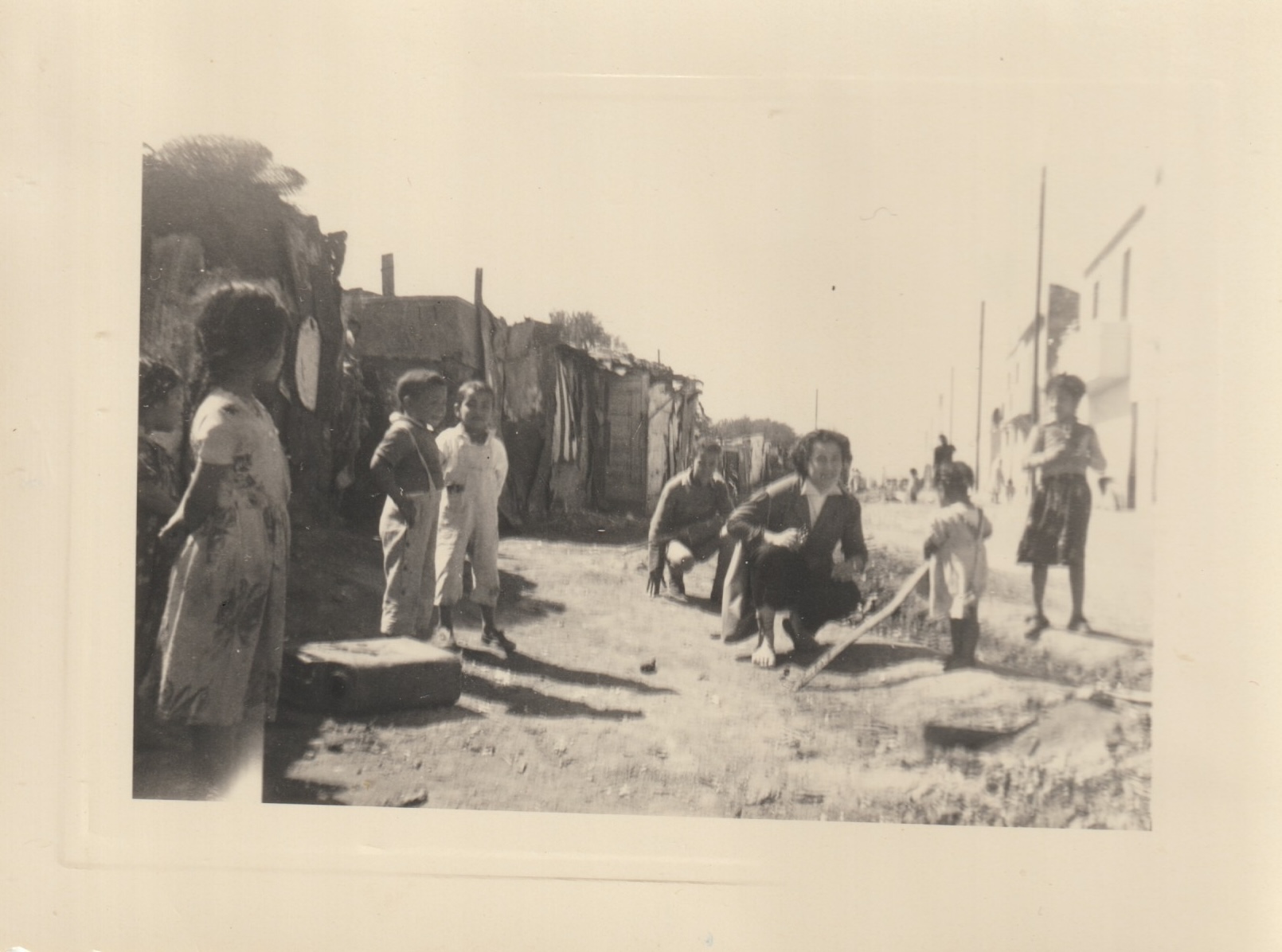
In 1955, after an earthquake devastated El Asnam, in Algeria, they joined the solidarity campaign initiated by the Secours Populaire, gathered blankets and non-perishable goods and embarked to cross the Mediterranean Sea to distribute what they had collected to the disaster victims. The picture was taken during that mission, on the ruins of the then-called Orléanville. Janine’s white collar, always impeccably ironed, lights up the screen on which I zoom to try to discern her features.
They both turned their back on the French Communist Party when it approved the deployment of conscripts in the country. She had already struggled to swallow the crackdowns in Budapest, now the endorsement of a colonial war was just too much to bear. They shifted towards the NLF (National Liberation Front), helping as they could, carrying suitcases without being aware of their content across the Marseille’s bay.
Jeannot wanted to come back to Algeria, to be useful to those people that were fighting for their singularity, against colonial domination… Or to escape the loneliness in which the Party had plunged them since they resigned.
And so, they left, the not so French that were traveling against the tide. When most Europeans were setting off with despair, they were the ones that had decided to settle down, in Hydra, on the heights of Algiers. They were people of passion, not always right, but not always wrong, either.
I sometimes wonder how the two of them can be dead. How so much vitality can one day cease to flow through the vessels to simply disappear without leaving any trace of its existence but some old black and white photographs and some vague resemblance in the shape of my nose. Him, so passionate it could have consumed him whole, sipping tea with the president of the time, Ahmed Ben Bella, discussing the future of the nation, to, the next day, catch a glimpse of Che Guevara before his speech in Alger. Her, at a time when women couldn’t open their own bank account, getting a driver’s license and driving a Beetle down the Sahara’s dunes, my aunt on her lap and a cigarette between the lips. How can she now seem so calm on paper? Why can’t she just reach out for my hand, taking me to those times where another future may have been possible? I need her to explain to me, how she kept faith, how she was able to stay away from cynicism and actually believe in something. Why can’t she explain what is essential for me to understand before I, as her, cease to breathe.
Nevertheless, the only thing I can grasp is this smile, laconic and tender. And those eyes, that already know what will happen next.
Photos