
When the Past Does Not Let Go
About the Creator
I am a PhD student in Vilnius University. I research cinema and Russian imperialism.
One of my first signs of childhood awareness was a naïve question: why did my grandparents sleep in separate beds? I never received a clear answer. Now, as an adult, I think I can guess. It was because of a photograph of my grandmother’s father. Sometimes the past does not let go.
My grandmother, Ona Aldona, was born in July 1940 in Merkinė, in southern Lithuania. She was born a twin, but her brother, who was never given a name, died during childbirth. My grandmother often told the story of her birth: her father, shocked by the dead child, placed his wife—who had just given birth—into a hay-filled cart and drove her to the hospital in Alytus. There, my grandmother entered the world.
Two years later, during the Nazi occupation, her father, Stasys Skaržinskas, was shot together with ten Jews from Merkinė. He was not Jewish. Why was a 32-year-old father executed? What has to happen for one person to want to kill another? These questions followed my grandmother throughout her life. They were never answered. Sometimes the past does not let go.
We can accept death more easily when we can place it within a meaningful structure—most often, the cycle of life. Life ends; this is natural. But that framework does not explain murder. When there is no explanation, loss and the possibility of a broken or never-fulfilled bond may take material form in objects, habits, and gestures. In my grandmother’s case, her relationship with her father—necessary, but never truly lived—became embodied in a single photograph.
I remember three images that hung in my grandparents’ apartment, in their garden house near Vilnius, and in their summer cottage in northern Lithuania: a portrait of Vytautas the Great, a map of the Grand Duchy of Lithuania at the height of its expansion, and a photograph of Stasys Skaržinskas. Together they formed the mythology of my childhood: lost greatness, wounded history, and unrealized possibility. Sometimes the past does not let go.
Years later, I found a newspaper clipping describing my great-grandfather as a fighter for an independent Lithuanian Soviet republic, murdered by the Nazis for his political views. For a moment, the story seemed to make sense: the Nazis had killed a political enemy. But when I asked my grandmother why she had never told me this, she was embarrassed. The article, it turned out, had been fabricated by a relative to help my grandparents move faster through the queue for a state apartment. They got the apartment. Her father helped again—through fiction.
As she aged, my grandmother’s working memory weakened. She forgot what had just been said but remembered poems from childhood. She never forgot her grandchildren’s names. And as her memory declined, the importance of her father’s photograph only grew. She took it repeatedly to photo studios: to enlarge it, reduce it, colorize it, reframe it. On bright summer days, surrounded by family at lunch, she would suddenly grow sad and ask again the same unanswered questions. Sometimes the past does not let go.
When Roland Barthes writes about the Winter Garden Photograph, he distinguishes between studium and punctum. Studium is the public, readable dimension of the image: what it shows, what can be named. Punctum is what pierces us—an accidental, irreducible detail that resists translation into clear meaning.
My grandmother’s father’s photograph was an unending punctum: an unhealed wound, a trace of impossible and unrealized life.
What Barthes does not fully confront is what happens when punctum is left without a mediating studium—without a shared public language capable of placing pain in relation to meaning. Under Soviet occupation, in an atmosphere of fear, violence, and institutional falsehood, such a space was gravely damaged. Senseless cruelty could be narrated, exploited, or mythologized—but not truly shared and worked through.
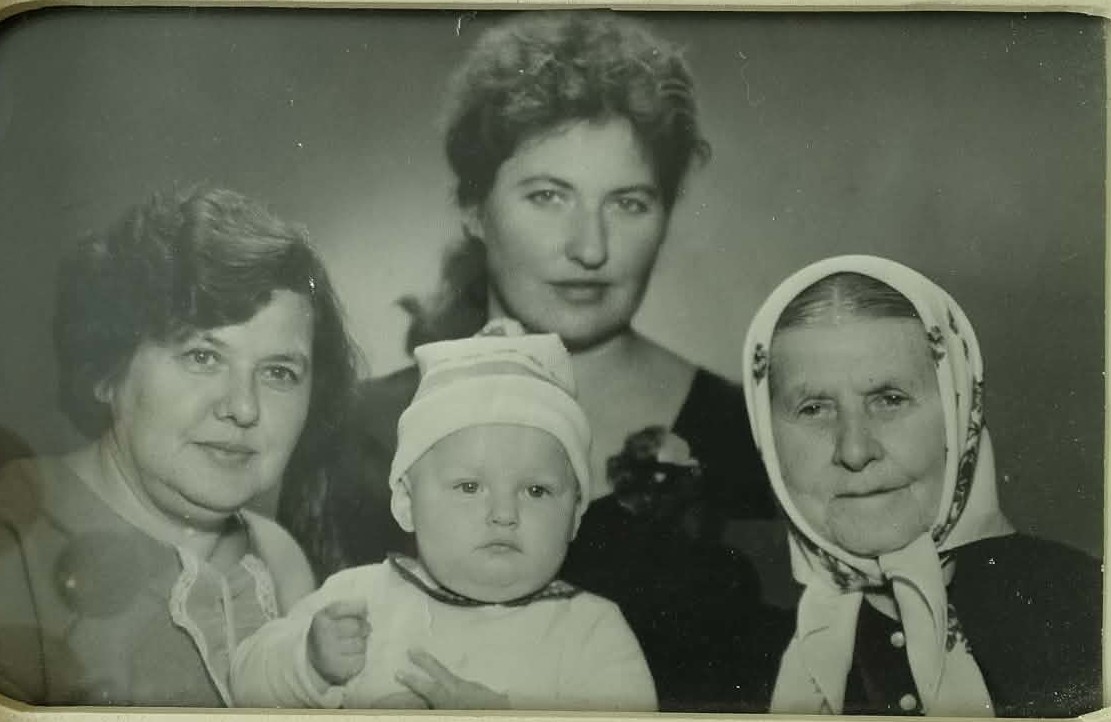
For my grandmother, the opposite of meaninglessness was not ideology but love: her bond with her grandmother Petronėlė, with her mother Felicija, and her immense love for her daughters and grandchildren. I know this because I received that love.
Only in a community that speaks, that does not fear its past—and, even more importantly, does not fear its future—can there be a studium strong enough to limit the power of punctum. Such a community is a community of truth: not truth as abstract correspondence, but truth as a human virtue composed of courage, sincerity, and empathy.
Truth allows us not to forget. But it may allow us, at last, to leave the past to the past.
Photos