
The Medal PRL – a capsule of the history of my grandfather and the history of Polish in the twentieth century.
About the Creator
I am a fifth-grade student at Elementary School. I like to play soccer, and I am interested in board games, especially D and D.
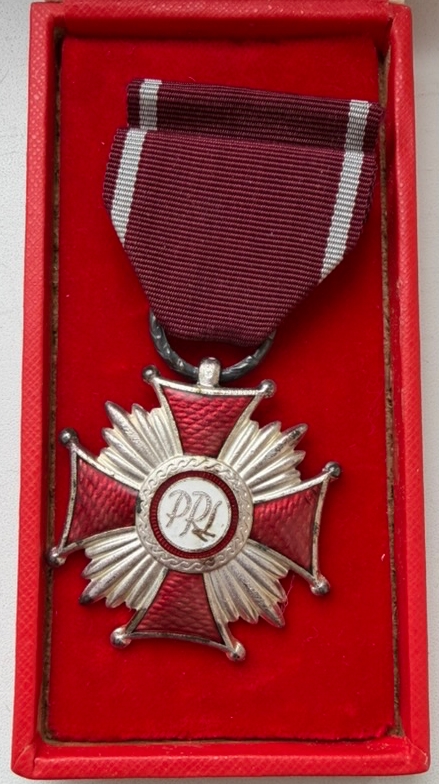
My grandfather has an object in his house that will seem small and innocent. It is a medal of the People's Republic of Poland, which was awarded to meritorious employees of the Factories for their long work. My grandfather received it for his work at the Lenin Steelworks for 10 years of work and he has a silver medal.
The medal is a family souvenir, but also a souvenir of the times of the People's Republic of Poland and the changes that followed. The medal is heavy, metal and brings to mind something "serious", not a decoration, but a reward for work, which was hard in Huta.
Why is this medal important? To understand this, you need to learn about the history of Huta a little more broadly.
In 1947, a decision was made to build the Steelworks, and its construction began in 1950. The construction of the Steelworks was presented as a "gift from Lenin", a symbol of friendship between Polish and the USSR.
The smelter was officially opened on July 21, 1954 - then the blast furnace was put into operation. A lot of workers worked in the factory, so next to the Steelworks was built the current district of Krakow – Nowa Huta, which was a typical workers' city built for workers. The oldest part of Nowa Huta is considered one of the best contemporary concepts for urban development. However, my grandfather does not live in this part, but in the so-called blocks of flats, which began to be built later and were no longer as beautiful as the older part. The construction of the "old" Nowa Huta in 2024 has been entered on the list of monuments due to its unique character.
Working in the factory was hard and difficult due to the high temperatures and working at heights. Everyday life at that time was also very hard, people often stood in queues for food, which they received on cards, and the shops lacked everything.
In the 1980s, the Lenin Steelworks became a place of strikes. On December 13, 1981, the largest opposition strike in Małopolska began there due to the declaration of martial law by the authorities. The steelworks became a place where employees united in defense of values and freedom. The Steelworks became the headquarters of the strike again in 1988, when attempts to overthrow communism began in Poland – on April 26, 1988, the workers of the Steelworks in Krakow began the "Solidarity" movement. People gained hope that Poland could be free, and it was in 1989 that communism ended in Poland and democracy was born.
A year later, in 1990, the smelter stopped using Lenin's name in its name and was named after Tadeusz Sendzimir – a Polish engineer and inventor who was known all over the world. The name change was to show that times have changed. Since 2007, Huta has been operating as a branch of Arcelor Mittal Poland.
In order to understand life and work in the times of the People's Republic of Poland, I conducted an interview with my grandfather.
Why did you start working at Huta?
At that time, it was the only factory of such a large size offering work, and since I lived in the countryside, working in such a plant was something at that time.
What do you remember from the strikes? What did you feel? What is ZOMO?
I think most of all I remember fear and pride. Pride that we are able to organize ourselves in such a way despite such control by the State, that we work together for a better tomorrow. When martial law was declared and my colleagues were taken out of their homes at night by ZOMO, i.e. the Motorized Detachments of the Citizens' Militia, established to liquidate such strikes, I was really afraid, because I already had a family and your mother, who was three years old in 81 and 11 in 89. In 1989, when there was a chance to change the Polish government, the mobilization of people was the greatest, and the factory was full of striking people. And we succeeded.
How did you feel when communism ended?
Happy, but also nervous about how it would be, because something new awaited us. But it worked out. Work at Huta continued, and this gave a sense of security.
Does this medal mean anything to you, what emotions does it evoke?
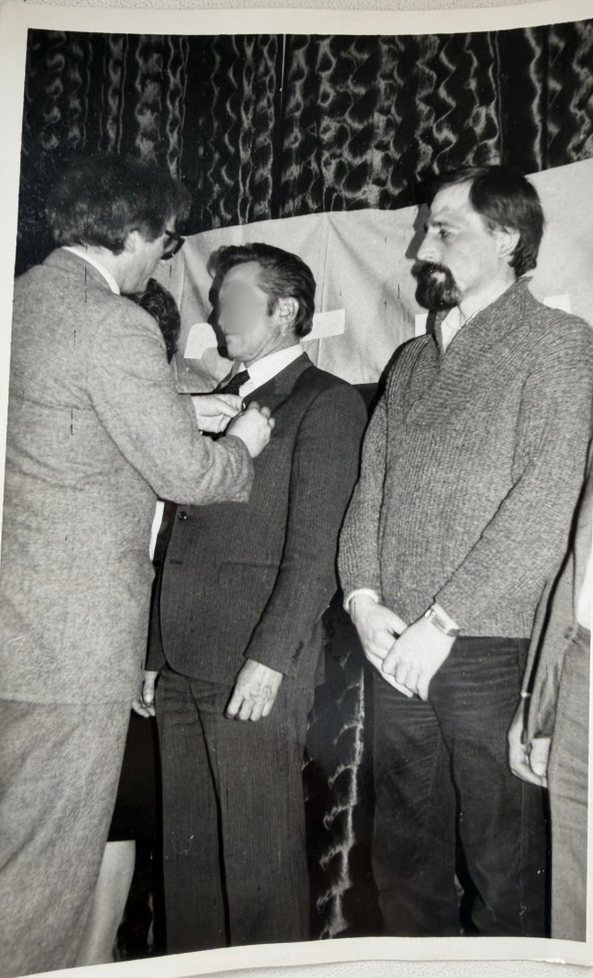
Now it is a souvenir of the People's Republic of Poland and difficult times, then I was proud, because such a medal is a great thing, look how in the photo I was unfastening the cage for the medal. And thanks to this conversation, I remembered that I had him and we reminisced.
My grandfather's medal shows that history embraces us. Thanks to this work, I saw that history is not only about wars and kings in my school books. It is also the story of my grandfather, who lived in the era of the People's Republic of Poland and now, and this medal shows me how much history can change during the life of one person, that history does not exist somewhere far away and that it is also in my family.