On the Topic of the Conference “Sites of Memory in Central Europe – Experiences of the Past and Perspectives”
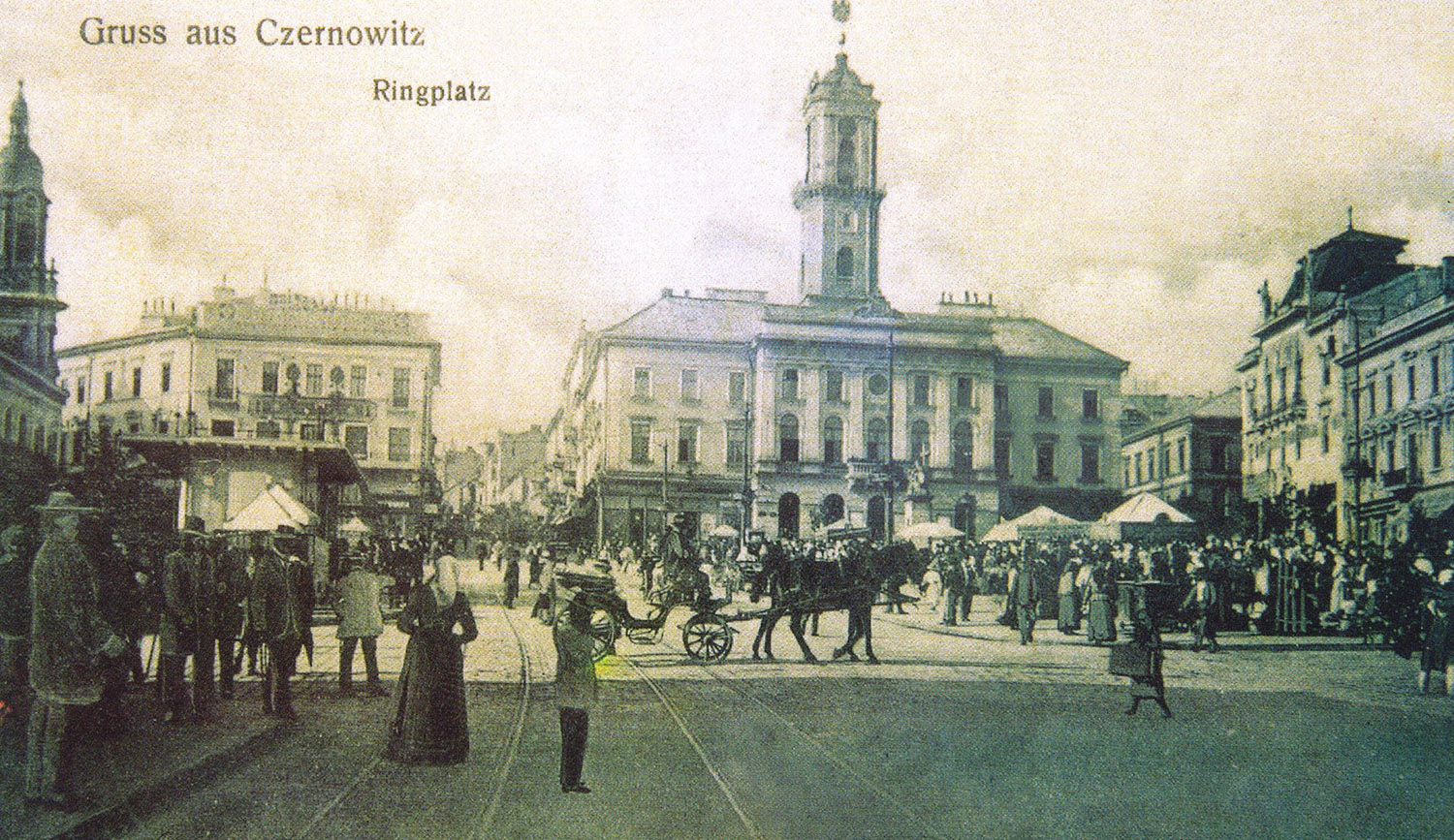
Bucovina was one of the so-called “crown lands” of the multi-national Habsburg monarchy since 1849. The traditional capital of Bucovina was a Moldavian-Romanian city founded in the second half of the 12th century; a city which bears the name Czernowitz – sometimes also spelled Tschernowitz – in German, and called Chernivtsi in Ukrainian, Chernovtsy in Russian, Cernăuţi in Romanian and Czerniowce in Polish. Today the city is the administrative centre of the Ukrainian Oblast Chernivtsi.
Czernowitz stands for many different memories: for some it is the eastern-most centre of Austrian-German culture: “a colourful city in which the Germanic cultural heritage was permeated by the Slavic, Latinate and Jewish cultures,” as Rose Ausländer once wrote; for others it is the city of Paul Celan’s Todesfuge. For yet others Czernowitz is the former centre of the Bucovina Germans, forsaken after their resettlement, or a – lost – centre of Romanian intellectual life. For most of the city’s inhabitants today, Chernivtsi is a Ukrainian centre, newly renascent after the leaden years of Soviet rule.
For very many, Czernowitz/Chernivtsi is also a site of memory – a memory of the coexistence of Ukrainians, Romanians, Germans, Poles and Jews. They hark back to the times when different religions and cultures were mutually tolerated in a European spirit, when – as Georg Drozdovski described it – one could live well “in those days when no Satan had as yet inoculated intolerance and nobody was inferior by virtue of his language or race”; they are remembering a place they wish to return to or which they yearn for. And thus, the memory of the site ‘Czernowitz’ is illustrates and encapsulates the topic of the international conference “Sites of Memory in Central Europe – Experiences of the Past and Perspectives” held in January 11-13, 2008 in the Royal Castle in Warsaw.
With the coming together of countries in the European Union, European nations have already achieved a consensus in many fundamental questions, even if numerous details of future collaborations are still unresolved. With the continent’s political union the chances have increased that the people in eastern and western Europe will not merely learn about each other, but will also form their own judgements and, in doing so, will move closer together. Now, they are not merely asking the question how the future can be shaped collectively, they are also looking back and asking which stages of the past require a collective remembrance. Memory is always subjective, affecting the individual people or groups who directly experienced an event – for example the barbarity of war or the forcible destruction of evolved structures and identities, including the Holocaust. The discourses within and between societies show that in Europe the interest in a certain type of memorial culture is growing, interest in a memorial culture which draws comparisons, discovers analogies, and creates connections across national borders.
Today the question arises in which channels a bi- or multilateral collective memory within Europe could run. How, against the backdrop of the experiences of the 20th century and in view of the unique Nazi crimes committed by Germans particularly in Eastern Europe and Poland, can a common language be found for neighbours to tell each other their stories and exchange their experiences? Where do collective sites of memory lie? Do they even exist?
In Central Europe there are numerous places which – similar to Bucovina with its capital Chernivtsi – have been shaped by the diverse relationships between ethnic groups and religions. Interconnections and multiple encryptions of one and the same site of memory are characteristic for Central Europe. Thus Poles, Ukrainians, Jews, Slovaks, Germans, and Ruthenians associate quite different meanings and memories with cities such as Pressburg/Bratislava/Pozsony or Lemberg/Lwów/L’viv. Over the centuries, many regions have been given a double or even a multiple historical, political and cultural identity as the result of changes of rulers, (forced) migrations of populations, and changes in religion. Historical events and upheavals and their corresponding dates have different meanings and contents in every country of Central Europe and are discussed in different contexts. The historical relationships between ethnic groups manifest themselves in the collective memory of nations, among other things, in the form of different memories of one and the same site of memory.
The term “site of memory”, as it is used here, encompasses the memory of a concrete, topographically defined site, that is, of a particular city, a region, a river or another geographically determined place. A memorial, a concentration camp, a burial place or a monument can also be a site which is anchored in a particular manner in memory. But the term “site of memory” is also used in a broader, figurative sense as a metaphor. The French historian Pierre Nora coined the term lieu de mémoire to describe this connotation that historical events, personages, institutions, books, works of art and other cultural artefacts, historical dates or terms can be – in a figurative sense – sites of memory. Such sites of memory in the figurative sense are often “long-lasting, focal points of collective memory and identity which survive over generations,” as Étienne François und Hagen Schulze put it in the multi-volume work they edited on German sites of memory Deutsche Erinnerungsorte. The “Battle of Tannenberg/Grunwald” or “Nicolas Copernicus” can serve as examples for this or the sites of memory Katyń” or “The Year 1945” discussed in the present documentation.
With the conference concentrating on such collective, metaphorical “sites of memory”, the focus was less on concrete historical events or particular circumstances. The point is not to re-explore the course of history, to reconstruct it and if possible to agree on an objective result. The focus of interest is rather on memory as a phenomenon which is subject to permanent reconstruction; consequently the focus is on continuities and changes in individual memories and in the collective memory of historical events and circumstances as well as on the discussion of why memories have found such different expression in European nations. Today, in the wake of totalitarian systems, two world wars, forced migrations and the drawing of new borders in the 20th century, many sites of memory now have a different sense and have been given a different meaning. Many places exist almost only in a “musealised form” in memory. The memorial landscape of Central Europe must be imagined as a mosaic of islands of memory, which began to compete with each other in the age of nationalism.
The discussion of collective sites of memory aims to expand the perceptions and the appropriation of these sites by constructively developing the opportunities offered by transnational sites of memory. Because shared but divided sites of memory do not inevitably have to be antagonistic but can contribute to overcoming their inherent contradictions.
We need to be careful not to produce (new) stereotypes out of mistaken political correctness. Democratic societies develop their pictures of the past in the thrust and parry of social discourse; it is not necessary to invent a uniform, normative view of history. In the Europe of today, which is finally on the cusp of overcoming – also mentally – the unnatural dividing line of the “Iron Curtain”, the point is rather to compare differing concepts of history and memories and thus to awaken mutual understanding and empathy for the memories of respective neighbouring societies.
In the last one-and-a-half decades, historical research has begun to focus more on common pasts. There has been an emphasis on an examination of sites of memory – initially such examinations were carried out within national frameworks but now, for some time, the interest has turned to supranational, European sites of memory. This is also the context in which this documentation of sites of memory in Central Europe must be viewed. It treats two key aspects, which can be summarised by the two following questions: What is the relation between the history of the 20th century, as it is currently discussed in research, and the memories of the self-same history held by national communities, and how can the differing memories of people and nations be brought together and connected to each other?
In the following, the focus is on concrete sites of memory and figurative sites of memory. The grouping into: 1. Cities as transnational sites of memory, 2. Sites of memories of totalitarian systems, and 3. Historical upheavals as divided memories –1944/45, 1956, 1968, 1980/81, 1989, is based on that of the conference panels.
The exploration of this topic allows the different meanings of material and immaterial sites of memory in Central Europe to be identified, and similarities and differences to be elucidated, thereby developing an understanding of the memorial cultures of others. The nation is revealed as a community of memory in the classic sense with all the associated problems, and a reciprocal appropriation of transnational sites of memory is promoted. A multi-ethnic perspective allows demarcations and interconnections to become visible and contributes to a dialogical memorial culture in Europe.
translated from German by Helen Schoop
prof. Matthias Weber (born 1961) - historian, Germanist. Since 1999 associate professor in University in Oldenburg. Since May 2004 director of Federal Institute for Culture and History of Germans in Central and Eastern Europe. Member of Steering Committee of the European Network Remembrance and Solidarity.