
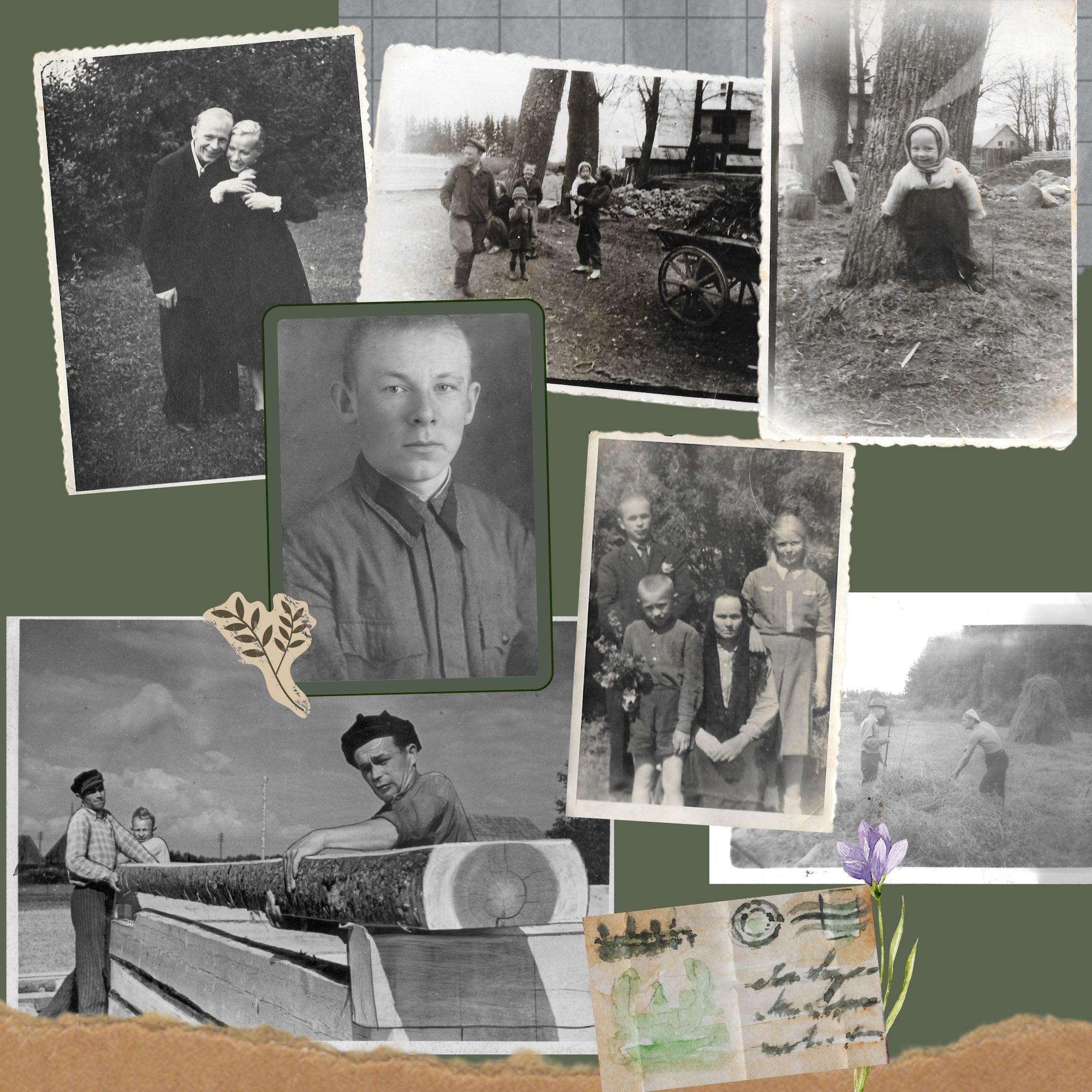
My Great-Grandfather's picture
About the Creator
I am studying in 12th grade at Tartu Jaan Poska Gymnasium in Estonia. I plan on studying history in university and have studied my heritage, especially the Ingrian Finnish side, for at least the last three years.
I have never met him. Juhan was an Ingrian Finn (1922-1999), born in the village of Kesälä, Leningrad Oblast. War brought him to Estonia.
My family’s treasure is a picture of Juhan in a soldier's uniform taken in Ingria in the 1930s.
This and other photos are bases for the story from his perspective.
All of a sudden, my surroundings fall silent. Here, in Staraya Russa, in November of 1941, the surrounding noise is drowned by a ringing in my ears. My whole body is squeezed out of the air and strength. My leg hurts like crazy. I lie under a heavy load like a warm blanket, and panic seizes me. Only a few hours later, do I begin to see something. When I’m dug out under the rubble. After my recovery, I am sent to train as a medical instructor. It takes many more months for my hearing to return.
In 1944, I am 21 and back on the front line. We chew our sawdust bread slowly because soldiers, too, are short on food – 200 grams per person. Some who seem to know more than I tuck chewed bread back into their breast pockets like candy, so they can put it back to their mouths later. It is unspeakably cold, and our cheeks are flushed. We go from Leningrad’s one icy apartment to another. Many doors are locked, so they have to be broken down with rifle butts. We find people, either dead or alive, but mostly dead. We carry those who still have a breath of life left within to freight train bunk beds. They all ask for food. We bury many. Even in death, their bodies seem hungry, as if begging to eat to end their torment finally. Except that the end has long since come for them.
We gather behind another door. I step inside. Something heavy falls on my foot. It’s a person. Or rather, something that once was a person, who had mustered their last bit of strength to crawl to the threshold. Another soldier told me that he had a friend living in Leningrad. He went to visit. The door was locked. After his banging, the man opened, and well, they greeted. They exchanged a few words before the soldier asked his friend where his wife was. The man pointed to a corner of the room where his wife's bones lay. The soldier then grabbed for his rifle and shot his friend.
In the middle of the day, I am dragged from my workplace at Osinniki’s mine to the military commissariat. “Иван Николаевич?” They sit me down in an almost empty room. “Военный билет?” I am asked if I know where my father and family are. I shrugged my shoulders. “Well, your family is in Finland, and your father has been shot.” My heart starts racing. Something is crushing my chest, squeezing oxygen out. There is ringing in my ears. As if I were back in Staraya Russa, only now there is no one to dig me out.
They give me documents with names and dates: isä Nikolai, ämmä Anna, sisko Niina, veljet Toivo, Peeter, Väino. The Nazis shot isä in 1941; ämmä, Peeter, Niina, and little Väino are in Finland. Turns out Toivo is also dead, hit by a mortar shell in 1941.
Although paper is scarce in 1948, I send a small note to my home village, hoping someone might receive it. Soon, I get a letter in return. I never thought to expect one and quickly tear open the envelope. I pause a moment as I don’t dare to read right away. My hands start to shake terribly. Tears well up in my eyes. It is my sister Niina who is writing to me.
I wake, grasping for air. It’s as if I haven’t been able breathe normally for the last six hours. Screams in my head quickly subside, and blood splatters evaporate into glittering snow behind the window. As usual, I have fallen asleep in my rocking chair while reading Pravda. Except there is no Pravda anymore. There’s no war or life in a Siberian mine. Instead, there’s Estonia, my home in Vastse-Kuuste, and the newspaper Koit.
My first impulse is to look for Liida. It’s eerily quiet without her, even though our life together was what it was. We fought, and yet it’s somehow strange to think that she is no longer here. “Strange that the only one left to talk to is a dog," I confess to my grandchild at Christmas. Liida kept a picture of me, young me, on her nightstand until the end of her life.
My children and their children do visit, but no one asks about stories from the war anymore. Funny to think I told my grandchildren bedtime stories about the rifle corps, showed them my medals, and the healed-over bullet holes in my leg. But back then, when little Hannes eagerly asked if I had ever shot a person, I grew quiet. Only ringing in my ears. That same ringing.
I call my sister and wish her happy holidays. I never tire of repeating my gratitude to her. "I always remember when your first letter arrived at the mine and when you sent those other letters and packages. Sister, you saved my life."
We sit on the sofa with my granddaughter Mariliis, we watch TV, my strong black tea steaming on the table, and we stay silent. This is how Christmas of 1997 passes. First ones without Liida. Yet there is some indescribable relief and peace in my soul.