
Diado Kamen - A True Comrade
About the Creator
My name is Dr Kremena Dimitrova, a London based illustrator-as-historian and educator. I hold a PhD in visualising history from the University of Portsmouth and currently work as an arts-based postdoctoral researcher at Oxford Brookes University.
A description of your family treasure – What is it? Where did it come from? Who owned it?
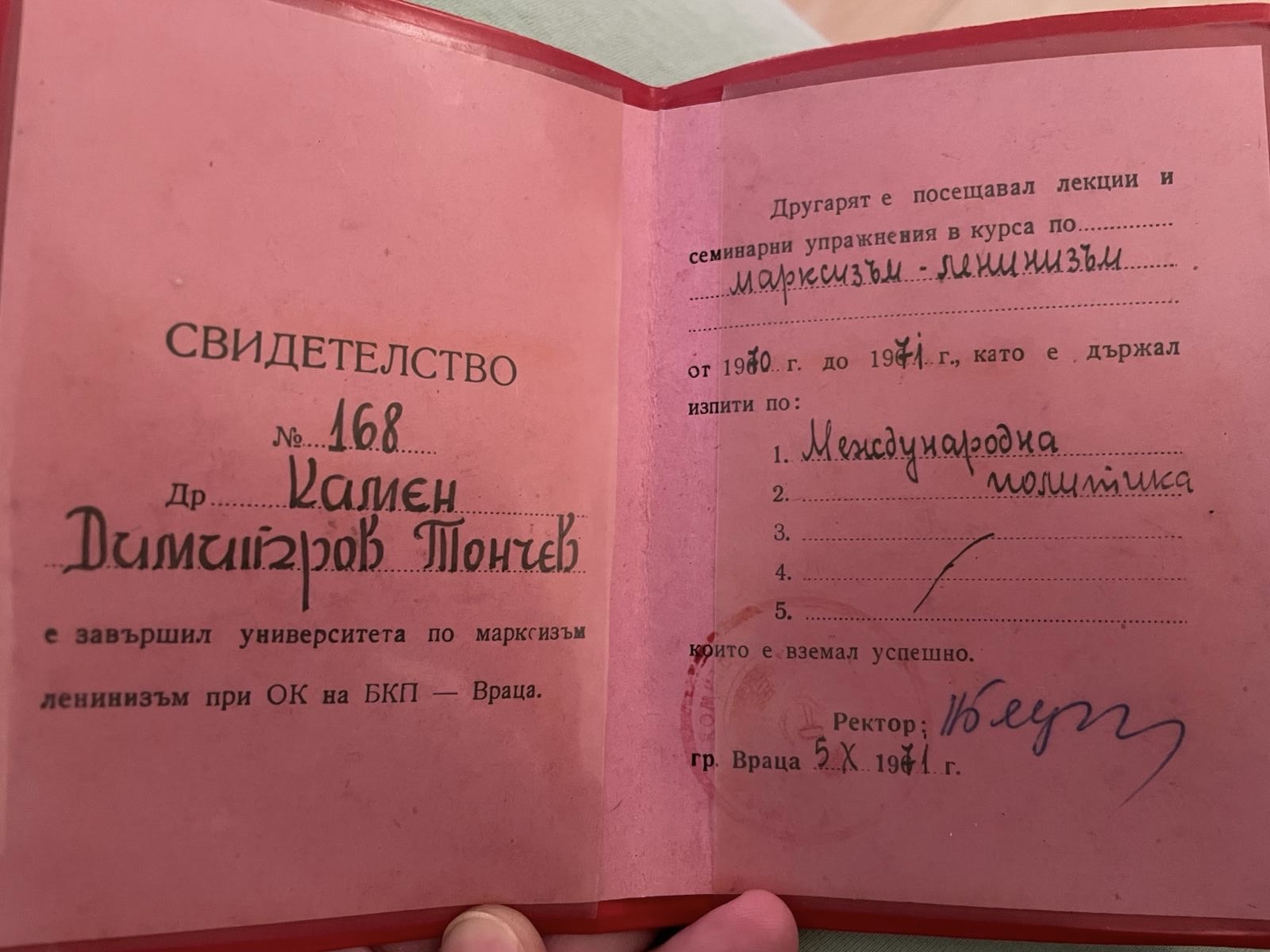
As a socialist state in Southeast Europe, Bulgaria was heavily aligned with The Union of Soviet Socialist Republics (USSR) (the Soviet Union)—one of the biggest ideological experiments in human history at state control of millions of people. Bulgaria was a key member of the Soviet-led Eastern Bloc from around 1945 to 1990, so were its people. This university certificate, typed and handwritten in Cyrillic, was awarded to my father’s father in the city of Vratsa on 5 October 1971, stating,
Comrade, Kamen Dimitrov Tonchev, completed university in Marxism Leninism Пpи OK на БКП
— Враца. “Pri OK na BKP — Vratsa” refers to a Bulgarian Communist Party (BKP) district committee organisation located in Vratsa (“pri” means “at/with” and “OK” stands for “Okrazhen Komitet” or District Committee). Such phrases are commonly found in Bulgarian historical documents like this one, denoting a specific, regional party unit, related to administration or political organisation under the BKP during the socialist era.
The certificate then states that the comrade had attended lectures and seminar exercises in the course of Marxism - Leninism between 1970 to 1971, having held exams in International politics, which he took successfully.
Its connection to 20th-century history – How does this object relate to historical events or periods?
My grandfather’s university certificate serves as far more than a record of academic achievement during Bulgaria’s era of totalitarian rule; this certificate symbolized status which unlocked privileges for the cadres of the system, or in Orwell’s own words, “All animals are equal, but some animals are more equal than others”. Such certificates were state-controlled documents that verified political reliability, specialized training, and guaranteed state-assigned employment. Higher education was treated as a tool for creating a loyal, educated socialist workforce. A “red” diploma (with a dark red cover instead of the standard blue)—like my grandfather’s—as the photograph evidences, signified the highest level of academic performance, often combined with active participation in communist movements; indeed, my grandfather was a Mayor of village Furen, Bulgaria, for many years and took part in the local “Kooperatsia” (“Кооперация”)—state-controlled cooperative farms. This university certificate proves how the curricula were heavily loaded with Marxism-Leninism studies, further certifying that the holder was indoctrinated in the state’s ideology, believed in the system, supported the regime, and ‘preached’ its teachings. A quiet, serious, proud, strong, hardworking man—until the very end, my grandfather was a sworn communist.
The personal story – What memories or emotions are attached to this treasure? What does it mean to your family?
I never knew my grandfather had studied; not until the recent chance encounter with his university certificate, which my sister discovered in what was left of his belongings. As an academic myself devoted to lifelong learning, finding out about my grandfather’s academic achievements has brought an even deeper admiration and pride. And perhaps “diado” (grandfather) Kamen has passed his legacy of intellectual curiosity down through generations. I was named after him, after all. Kremena derives from the Bulgarian word “kremak” (кремък)—“flint”. It symbolises strength and endurance, as flint is a hard, durable stone. It is associated with the ability to spark fire, representing passion or creativity—I am an illustrator-as-historian. Kamen translates to “stone” or “rock”—a Slavic name symbolising strength and endurance. Due to its connection with nature, it reflects a solid, unwavering character, associated with firm foundations. My diado was defined by integrity, commanding respect through his actions, he kept his word, always acted with honour, helped and treated everyone with dignity, while staying firm in his principles. Diado Kamen was a true comrade.
Historical context – Show awareness of the broader historical background.
Kamen Dimitrov Tonchev’s university certificate is an aide-mémoire to 20th century communism—a period so momentous, that its shadow is still cast over Bulgaria and its seemingly unbreakable ties with Russia—the largest and leading constituent republic of the former USSR. And while diado Kamen passed away decades ago, many from his generation who survive him continue to nostalgically reminisce about Bulgaria under communism, and more often than not, they remember this contentious period in a fairly positive light. In retrospect, who am I to judge—I was only 5 years old in 1990 when democracy finally arrived in Bulgaria. What I remember is having to call my teachers “comrade” (“drugar/drugarka”) reflecting the socialist ideology and the Communist Party’s influence on education. While this formal address was part of efforts to cultivate a communist, egalitarian, and collective mindset in the school system, I was glad when comrade was replaced with “uchitel/uchitelka” (teacher). This shift reflected a post-1989 rejection of communist-era terminology and signalled a move away from ideological conformism—and I was quick to move away with it; yet I stay a true socialist.