

Dream and Legacy: The Story of the Rise and Fall of an Industrial Dynasty. The Klein Family of Seini
About the Creator
Dr. Klara Guseth, National Archives of Romania, Maramureș County Service
”Towns are built not only of stone and concrete but of the dreams of those brave enough to begin. In Seini, one of those dreamers was Leopold Klein”
In the northwest of present-day Romania, in a settlement first documented in 1334 as Synir, now Seini, a child was born in the winter of 1843 who would change the town’s economic destiny. This is not just the story of two factories, spirits and yeast (later also vinegar) and emery and abrasive materials, but the story of a family, a legacy shattered by the tragedies of the twentieth century, and a community that grew around a bold and visionary dream.
Leopold Klein, the boy who would ignite this legacy, was barely sixteen when he dared to transform a modest Austro-Hungarian market town into a regional economic landmark. His story extends beyond entrepreneurship; it is a story of ambition, vision, and the responsibility of passing a legacy to the next generation. It is also the story of his two sons, who carried this inheritance forward but could not pass it on, their lives and potential destroyed by the Holocaust. Ultimately, it is a call to recognize Leopold Klein as one of Seini’s most significant historical figures.
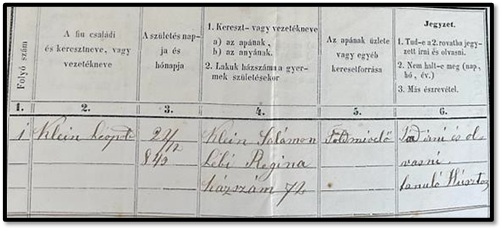
Born into a world of contrasts, Leopold entered a town where medieval traces lingered atop Castle Hill, noble estates dotted the landscape, churches marked the center of civic life, and a Jewish community was thriving. On December 22, 1843, Leopold came into the world as the son of Salámon Klein, a farmer and former teacher from Hust (now in Ukraine), and Regina Lébi. The Klein family was part of a generation of Jews who, after the 1722 edict of Count Károlyi, were allowed to settle in urban areas, contributing decisively to crafts and
commerce. Before 1940, Seini’s Jewish population exceeded six hundred—a lively, economically integrated community in the region.
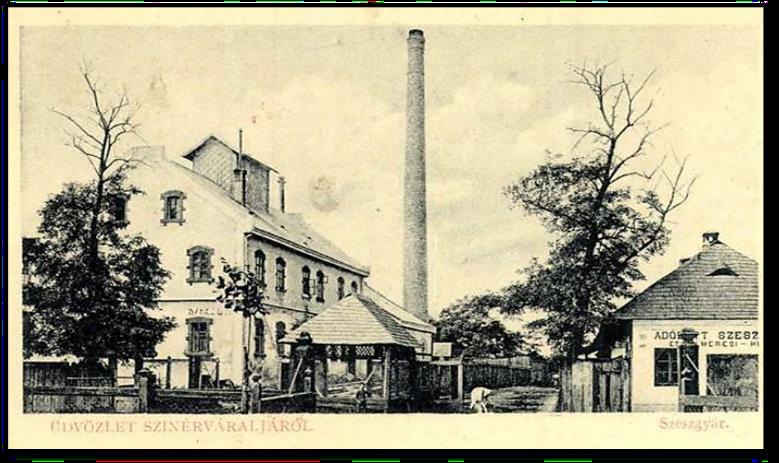
Yet Leopold’s success was not only a product of favorable circumstances. From an early age, he demonstrated vision and ambition. At just sixteen, he founded a spirit’s factory in Seini. What began as an audacious idea for a teenager, quickly became an engine of local development. By 1872, the factory received official authorization to operate with a steam engine—a symbol of industrial modernity. Its relocation to Kőutca Street (later Cuza Vodă) marked the consolidation of the business. By 1876, the company was registered at the Satu Mare Tribunal, and in 1888, it received permission to produce compressed yeast. Seini had entered the industrial era.
While most towns relied solely on agriculture, Leopold’s factory created jobs, stimulated commerce, and provided essential products for the region. The yeast produced was indispensable for daily life, while the spirits had economic and strategic importance. Leopold Klein was more than an entrepreneur; he was a community builder.
He married Pepi Friedman from Banat and had five children. Two sons, Elemér and Samu (later Katona Elemér and Katona Alexandru), would inherit and expand the family enterprise. The family’s name changes in 1901, from Klein to Katona, was a strategic decision, reflecting the era’s pressures for integration and professional recognition. Both sons became doctors, educated, modern, and connected to European industrial developments.
Elemér pursued specialized training in Budapest for managers of spirits factories, obtaining official certification. This was no mere formality; it was a rigorous program preparing industrial leaders for a highly regulated and technologically demanding sector. To qualify, Dr. Katona Elemér demonstrated six years of hands-on experience (1901–1907)
production, operational control, and technical management at the Leopold Klein Spirits and Yeast Factory. His examinations covered practical skills, spirits production and operational oversight, and theoretical knowledge, including yeast production, chemistry, arithmetic and geometry, machinery and boiler operation, legal regulations on spirits, accounting, correspondence, and nutrition studies. He passed with top marks and received official certification as a manager of an agricultural spirits factory.
This moment in 1907 marked the zenith of continuity: a visionary father, a skilled and certified son, and a business fortified through expertise and discipline. Tragically, history would soon interrupt this lineage, but by that time, Leopold’s legacy had been meticulously prepared.
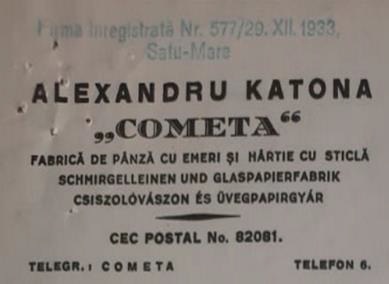
In 1917, the factory was modernized with a spirit refining installation. In the interwar years, Dr. Katona Elemér became the sole owner. His brother, Dr. Katona Alexandru, founded the Cometa Factory in 1933, producing emery cloth and abrasive paper. Seini now boasted two thriving industrial units, both born from Leopold’s adolescent dream. The father had dreamed; the sons expanded the dream.
By the 1930s, dozens of employees worked in these factories. Yeast was loaded daily onto trains for distribution, and the emery factory supplied industria workshops. Seini had become an industrial hub, a testament to vision, innovation, and enterprise.
In 1940, Northern Transylvania came under Hungarian administration through the Vienna Award, followed by anti-Jewish measures. In 1944, Seini’s Jewish population was ghettoized and deported to Satu Mare and then to death camps. Of over 19,000 Jews from Satu Mare, only 25 returned. The Katona brothers, Elemér and Alexandru, were deported, recorded as “absent for a prolonged period and in an unknown location.” Leopold’s legacy could not be passed on. The thread of this industrial dynasty had been broken.
After the war, the factories were briefly returned to their owners but soon nationalized. The spirits factory became “Seineana,” a state industrial enterprise; the Cometa Factory became the Abrasives Enterprise. The communist state modernized and expanded production, adding new halls and innovative products like reflective microbeads for road markings. Production increased, but the Klein name disappeared. The legacy persisted, but without heirs.
After the Revolution, privatization and restructuring followed. Once vibrant industrial platforms fell into partial use or disuse, leaving only memories of a bygone era.
Leopold Klein’s story is ultimately about courage, vision, responsibility, and the tragedy that halted the transmission of a legacy. There was no third generation to carry the torch. History intervened. Yet beyond tragedy and nationalization, one truth remains: towns are built not only of stone and concrete but of the dreams of those brave enough to begin. In Seini, one of those dreamers was Leopold Klein.