
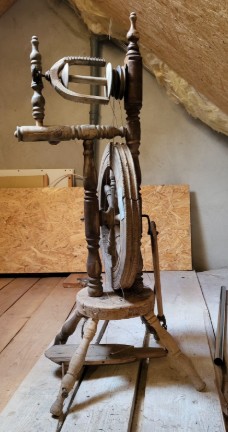
A Machine, Not a Memento: 73 Years with Józefa Praszkiewicz’s Spinning Wheel
About the Creator
I'm Leon and I'm passionated about public transport and horses. I love books and reading.
This is not a misty-eyed tale of sentimentality, embroidered doilies, or the warmth of a domestic hearth. This is a story of pure, functional immortality and gritty pragmatism. Józefa (née Praszkiewicz), born in 1930, belonged to a generation that didn’t ask if something was beautiful. They asked if it worked. She was raised in a world where objects were meant to serve, not to be looked at, and where durability was the only measure of value. The spinning wheel entered her life in 1948. Józefa was eighteen then, with a post-war Polish reality to navigate. She needed a tool that would allow her to survive, not a decoration for her parlor.
Engineering Survival: A Tool for Hard Labor
In 1948, no one treated handicrafts as a form of mindfulness or a way to unwind after a corporate job. Yarn production was heavy, daily, functional labor. The spinning wheel was a production machine on a domestic micro-scale. Józefa reached for it whenever the situation demanded—when warm socks ran out, when children outgrew their sweaters, or when winter approached and shop shelves, true to the era's tradition, were empty.
This was not an object that stood at the center of family life as a keepsake. It was a reliable partner in times of scarcity. For decades, it ended up in the attic, in a dusty shed, or in the entryway, covered with a cloth. It could sit unused for months, but when the need arose, Józefa would pull it out, clean it, oil it, and without any fuss, set it in motion. It served to transform raw wool into a tangible benefit. Józefa knew everything about it: how to set the tension, adjust the cord, and guide the thread so it was perfectly even and steel-strong. It was pure technique—craftsmanship in the hands of a woman who did not waste time on redundant movements or empty words.
Seventy-Three Years in One House: A Witness to Epochs
Although Józefa did not work at it every day, the spinning wheel accompanied her from the moment she entered adulthood until her death in 2021. The fact that it survived in her hands for seventy-three years in impeccable condition tells us two key things. First, it speaks to the quality of old-world craftsmanship, where wood and steel were designed to last for generations. Second, it shows that Józefa knew how to care for things in a way that is almost incomprehensible to the modern consumer.
Over those seven decades, the machine witnessed the change of generations and political systems. It saw times when wool was a basic material for survival, and times when it became a niche, almost luxury product. It stood in the corners of various rooms, gathering dust during peace and working at full throttle when life pressed against the wall. It watched as a young girl from the Praszkiewicz home transformed into a mother, a grandmother, and finally, the matriarch. The spinning wheel was a constant in a world that, on the outside, changed beyond recognition.
Indestructible Construction: The Anatomy of Durability
Modern devices, riddled with electronics and planned obsolescence, often wear out after two years. Józefa’s spinning wheel, in use since 1948, remains fully ready for work. This is simple, brutal, and almost flawless mechanics that require no software updates or authorized service.
- The Flywheel: Heavy and precisely balanced. Once set in motion by Józefa’s leg, it dictated the rhythm of the entire household. It was the heart of the machine, storing the energy needed for the steady turning of the spindle.
- The Spindle and Flyer: Components that wound hundreds of kilometers of thread. This is where raw fibers were transformed into a finished product. Every scratch on the wood represents thousands of revolutions that clothed several generations of the family.
- The Pedal: The most personal element. The wood is worn smooth by thousands of hours of pressure. It bears the invisible imprints of all of Józefa’s shoes—from heavy, leather post-war boots, through work shoes from the communist era, to the soft, indoor slippers of an elderly woman who, even at ninety, knew exactly how to give the wheel the right momentum.
The Epilogue of an Era
Józefa passed away in 2021 at the age of 91. She left behind an object that is physical, tangible proof that "to have" once meant "to care for, to understand, and to use." This spinning wheel is not a dead museum exhibit behind glass. It is an authentic, still-functional tool of a woman who did not accept half-measures.
The story of this object ends as the world has become intoxicated with what is cheap and disposable. But Józefa’s spinning wheel still stands. Ready, at any moment, to begin its rhythmic clatter again, turning raw matter into something useful. It is a monument to the Praszkiewicz generation—people who built their reality on a foundation of durability, not a momentary flash. It is a lesson in respect for material that we need today more than ever.