


A Newspaper That Carries a Century
About the Creator
I am a high school student with strong academic performance. I particularly excel in mathematics, physics, and geography. Alongside my education, I am also a professional football player, successfully balancing academics with competitive sport.
In our family home, one of the most meaningful things we keep is a fragment of a newspaper from 1947. It comes from Dziennik Polski, one of the major regional newspapers in post-war Poland. It contains an interview with my great-grandfather, engineer Mieczysław Mrazek. This small piece of print connects our family directly to an important moment in Poland’s twentieth-century history.
The paper is old and yellow. The edges are worn, and the print is slightly faded. At first glance, it looks like an ordinary piece of paper. But for me, it is much more than that. When I hold it, I cannot help thinking about how many hands may have touched it before and how carefully it must have been kept in our family. It is a real voice from the past - a voice from a time when Poland was trying to rebuild itself after one of the most difficult periods in its history.
The article is titled “Oil Ruins - Oil Makes Nations Prosper.” In 1947, Poland was still recovering from the destruction of the Second World War. Cities were in ruins, the economy was weak, and everything had to be rebuilt almost from scratch. Oil was one of the key resources needed for reconstruction and development. Reading the article today, I find it striking how strongly it focuses on the future rather than on the losses of the war. In the interview, my great-grandfather spoke about the importance of modern drilling technologies and about building a strong Polish oil industry. He believed that natural resources, if managed wisely, could help the country grow and become independent. It’s impressive that in such uncertain times he was speaking with confidence about development and responsibility.
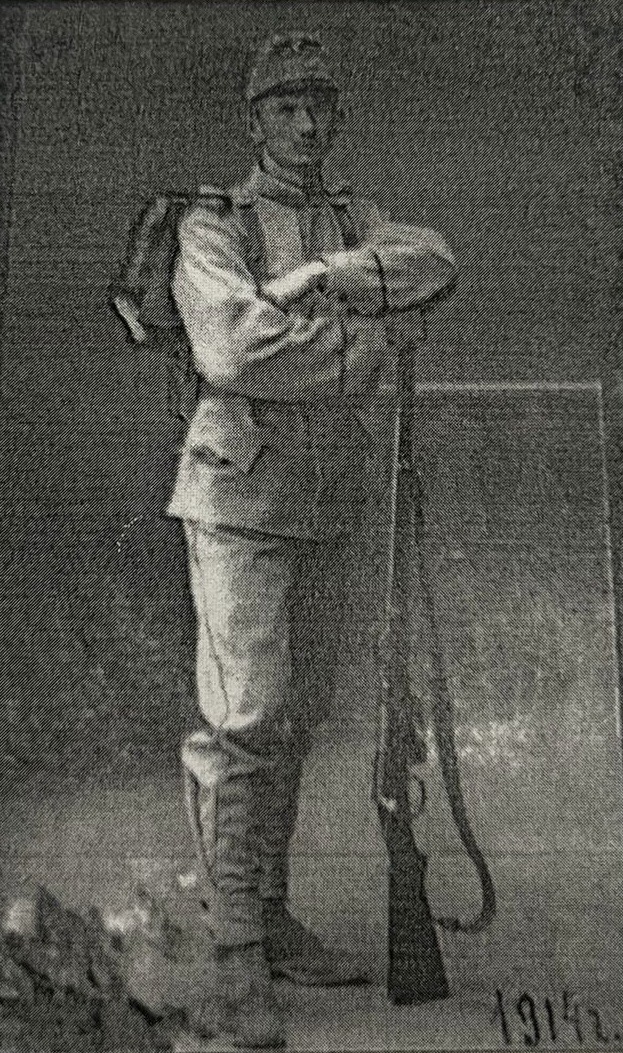
His life followed the complicated history of Poland in the twentieth century. He was born in 1893, when Poland did not officially exist and was still under partitions. He studied engineering and later served as a soldier during the First World War. When Poland regained independence in 1918, he devoted himself to developing the oil industry. He became one of the pioneers of modern drilling systems and helped design equipment for deep oil extraction. After the Second World War, instead of stepping back, he continued working and took responsibility for rebuilding this important sector of the economy.
This fragment of a newspaper was first kept by my great-grandmother and later given to my grandmother. I think that the fact it was preserved through generations makes it even more meaningful. It was not kept as an official document, but as something personal, a reminder of her father and of his contribution to the country. What matters most to me is that it shows him speaking in his own words.
There is also another reason why this story is close to my heart. As a young man, during the early years of Cracovia (the oldest sports club in Poland) my great-grandfather played football on the Kraków Błonia fields. He was part of the sporting community at a time when both the club and the country were shaping their identities.
Today, I play football professionally for Cracovia. Knowing that over a hundred years ago he stood on the same fields and wore the same colors makes me feel connected to him in a very direct way. In my family, he was the only person closely connected with sport before me and it was the same sport, in the same club.
This small piece of newspaper connects many layers of history: the time of partitions, two world wars, the rebuilding of Poland and even the beginnings of organized sport in Kraków. For someone else, it may just look like old paper, but for me, it’s proof that the story of my family is part of the larger story of the twentieth century, and that history is not only something we read about, but something we inherit.