
A Suitcase Full of Memories
About the Creator
I am Rebeca, a student coursing First of Bachellor. My interests include music (I play the piano), drawing, reading and sports (I practice taekwondo). I'd say I'm jolly, kind and fun.
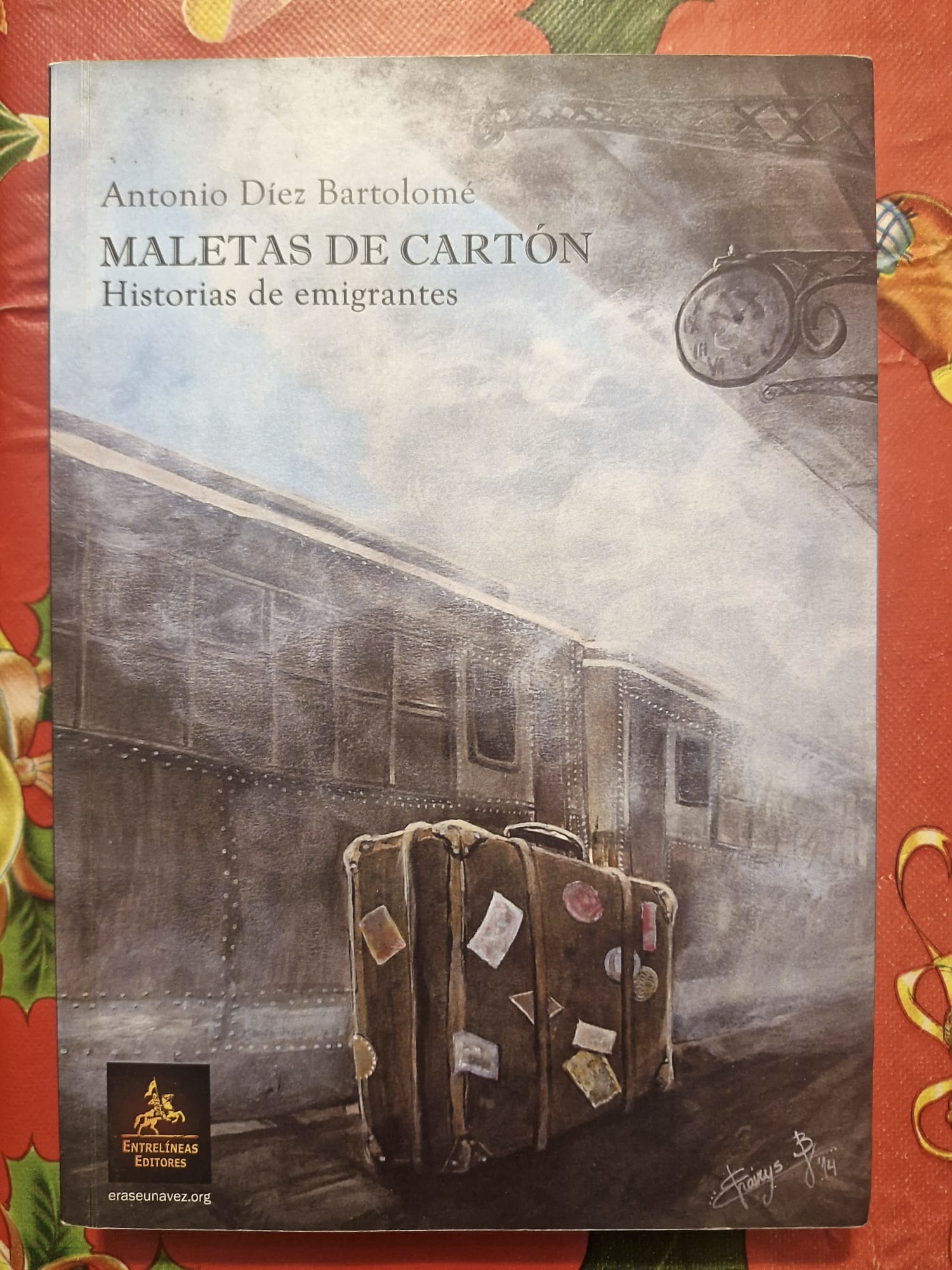
The treasure in my family is a physical copy of “Maletas de cartón: Historias de emigrantes”, written by my great-granduncle-in-law, Antonio Díez Bartolomé. The book tells the stories and experiences of an entire generation of Spanish emigrants, such as the author.
This particular copy didn’t come from anywhere or anyone specific, it’s my father’s, but that isn’t really important. It’s one of the first copies that first came out, it contains a dedicated message from Antonio himself. He gifted one to every family member he’s close to.
Its connection to 20th-century history
The book is deeply rooted in the historical reality of Spanish emigration during the mid-20th century, especially in the years following the Civil War. During this period, thousands of Spaniards crossed the borders in search of work and a better life in places like France, Germany, and other European countries. Some had so little they had to pack their few belongings in cardboard suitcases, from which they get their name.
The book portrays this movement through a group of emigrants. My great-granduncle-in-law writes about people like Amable and Fuensanta, who cannot distinguish between “un franco” (the French currency) and “Franco” (the Spanish dictator). This shows the little education, isolation, and political repression that shaped rural Spain under the dictatorship.
At the end of it there are photos of some of the emigrants, who mainly escaped to Germany, like Antonio. They met and married in Germany.
The personal story
For my family, this book carries emotional weight. It reminds us of our connection to the author, whom we sadly don’t see very much, as he lives in Madrid. And it represents the memory of emigrant ancestors and their resilience. It seems as though nowadays emigrants, for example from Romania, Latin America, or Muslim people, get hated on a lot, some even say they come here to steal jobs or whatever they can imagine, but the truth is Spanish people were emigrants too! I can’t even begin to imagine how hard your situation must be if you have to flee from your country, but getting rejected even where you went for, not a lazy, easy life, but a fair one, has to be horrible. Of course some may do bad deeds, but Spanish people do just as much every day. I don’t say the solution for their problems is to suddenly flood a country, but at least people could treat them with an ounce of respect, unless they truly don’t deserve it, but that’s rarely the case.
This is why it means a lot for our family, as, as they say, “Those who cannot remember the past are condemned to repeat it”.
Historical context
The time in which “Maletas de cartón” is set was one of political, social, and economic disorder in 20th-century Spain. After the Spanish Civil War (1936–1939), the country entered a long period of dictatorship under Francisco Franco, marked by censorship and severe economic hardship. Franco’s reign, which lasted from 1939 to 1975, limited freedoms and opportunities for ordinary citizens.
During the early decades of the dictatorship, Spain remained isolated from much of Europe, and its economy struggled to recover. Poverty was widespread, especially in rural areas, where education was limited and many families lived with scarce resources. This environment produced generations of Spaniards who felt forced to leave their homeland in search of work and stability. Although emigration had been restricted immediately after the Civil War, it resumed after 1946, and by the 1960s (the decade the book actually talks about) nearly three million Spaniards had left the country.
The novel reflects the reality of these emigrants, people who travelled with minimal belongings, often just cardboard suitcases, as I said before, and who faced the challenges of adapting to new countries while carrying the burden of separation from their families and country. In addition, they had to cope with learning a new language, which isn’t easy at all. In the school we have been learning English (one of the easiest, if not the easiest, languages in the world) for 11 years, give or take, and some of us still wouldn’t be able to hold a decent conversation with a native English speaker