
My Grandfather Centiu
About the Creator
I am Toma Calinici, I live in Cluj, Romania. The History Class is one of my favorite and I like to write, draw and ride horses. I also love to dream.
A few days ago, after a very long weekend, I casually entered my school, when I noticed that my history teacher had displayed a photo about a contest called “Grandparents. Grand Stories.” The moment I saw it, I started thinking. “What did my grandparents, or great-grandparents, do during World War II?”. And I wandered and wandered until I realized that maybe my grandparents really had done something during the 20th century, and I got more and more excited. So, I started to wait for school to end so I could finally go home and ask my grandparents about their lives during Communism. But then I realized that my grandparents live far away from me, so I asked my father and my mother for help. That is when I started to learn about my family’s history.
This writing is about my maternal grandfather, Centiu, and about how he served his country during The Communist Era in Romania.
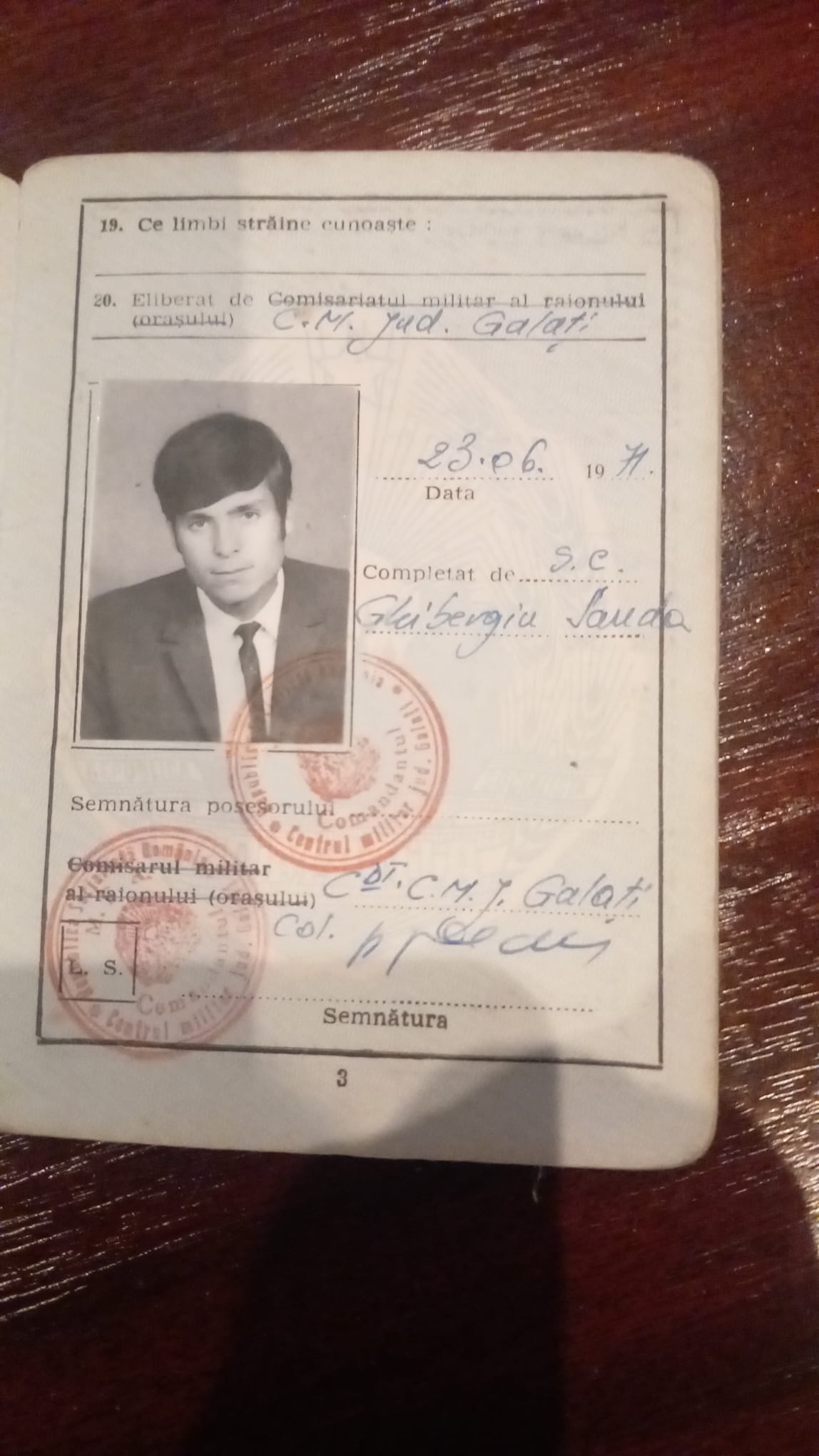
Back at my maternal grandparent’s house, there is a big, blue, wooden box, in which there are a lot of old documents. A few are just old school diplomas, or old photos. But deep inside, there is the incorporation paper of my grandfather. A yellowish white, passport-like document, that contains information about my grandfather. Such as his birthday, full name, the place he was born, even the military division he was in.
On 21st February 1970, my grandfather presented to the military unit to join the army, because, in Romania, during communism, it was mandatory to join the army if you were not attending university. After 3 weeks he finished training, when he took an oath, that said: "I, citizen of the Romanian People's Republic, entering the ranks of the Armed Forces, swear allegiance to the working people and the government of the Romanian People's Republic. I swear to defend the homeland, to respect the laws and military regulations. I swear to keep sacred the state secret and the military secret. I swear to be a disciplined, honest, and brave soldier, to spare no effort in mastering combat technology and raising the level of military training. I swear to hate with all my soul the enemies of the working people, of the homeland, and of socialism, and to strike them without mercy, wherever I may meet them. If I violate this oath, may I be struck by the harsh punishment of the law, may I be despised by the entire working people."
After he finished training, and took the oath, he and four other soldiers, were taken to Insula Marea Brăilei, an island on the Danube, because in 1970 there were a lot of floods in Romania, and soldiers were sent to watch the Danube for swellings. There, they were accommodated in a three stories high Security Building. You can imagine five soldiers, in such a big building, alone, with no one there to tell them what to do. All day they were walking on the dams, watching the birds, playing cards, all sorts of things, and they did their job too. All they needed to do was to watch the water and report to their superiors what they saw. And at night, they were sleeping on as many mattresses as they could carry. They did this for two months straight, until they were called back to the main base. Then they were sent again for two weeks at a military base in Medgidia, where they did their work and then they went back to their home base, because of a lee infestation in Medgidia. After they got back, they continued their work at a man-made channel, that connected with the Danube. He worked like this for a few months, and then the soldiers from the first cycle were sent to gather the corn. Back in the communist era, in Romania, and maybe in other countries too, the soldiers that just started training were the first cycle, then, they would go to the corn fields, work there and then they would begin the second cycle, in which they would be the ones that teach. After they finished gathering the corn, they came back as the second cycle. It was December, and it was snowing a lot. My grandfather told me that he remembered that when they were sent to watch the border, he used to make a small fire inside the watchtower and read all the books he managed to sneak with him. After the winter finally finished, he went back home.
But not everything was this “perfect”. During Communism, Romania wanted to look strong. So, what could they do if at that moment they didn’t have the resources for this? They would lie. But how? This was the question on every communist official lip at that time. They first started small, by introducing mandatory army training, but there was a problem, not everyone was good at being a soldier, so they started to invite journalists at the night shooting practice, where they would let only the best gunners shoot. But then, another problem came, they didn’t actually have enough tanks to look powerful, so they made fake ones. So, in the end, more than half of the tank division couldn’t really drive, or shoot, or do anything, except collect dust.
My grandfather’s brother, Marin, also worked in the military, he was a truck driver, and he usually drove the prisoners, the people that weren’t agreeing with communism, mainly old politicians. He drove them from one prison to another or to the execution.
At first, I didn’t understand why my grandfather hadn’t told me this story, but now, that I have listened the story I have recorded on my phone again and again, I understand that it was a hard period for all of the people in Romania. Next time when I will meet an elder man or women I will question myself what they did in the communist era, and I will ask them about their lives in those dark years of my beloved country.