
Grandfather
About the Creator
I enjoy playing the piano, writing stories and spending time with friends. My greatest desire: for time to just stop draining through my fingers already.
Sometimes it comes back to me. Memories of grandmother and grandfather, of all the times I went to their house, playing with the dogs and just lying in the trampoline, flat on my back, watching the stars in the evening and wondering when another one had appeared. Looking at them gives me a distant feeling, but lays me down in a dream, fantasies of what could’ve been. What if I still had some grandparents alive like so many other kids my age? The other set, the grandparents on my father’s side, went on while I was still little. I can barely remember them, honestly. The only thing I can recall was one time while I was running in the hallway. As I was skipping to the kitchen, I blazed past the mirror and then suddenly stopped. I was staring at myself. My short, curled hair (even more so than Hermione Granger’s herself, if you can imagine), my skinny dark blue pants from under my pink dress. My favourite dress. (I was only 4, don’t judge me!) But that wasn’t what I was so observing. No, under my right shoulder there was a stain, right on my favourite dress – my stained favourite dress. I hopped further carelessly. My mother, on the other hand, was the one making a fuss.
I never knew my grandfather from my father’s side. I do have photos with me as a toddler and him in the background. He didn’t manage it though. One of his hobbies – call it if you will – was drinking and smoking. He did have other ones on the bright side. My father very much enjoys telling me all there is to know about his dad. How he would make photos at any given opportunity and how he would write poems. “We didn’t have such cameras as there are today. It was all about light – always had to match it just right for the photo to look good.” He went on about how grandfather used the smaller lavatory for developing his photos – turned it into his laboratory, told me about how big those devices were and how he used to hide the bottles of drink in there – he and Aunt Lia would always find them though and grandma knew all about his habit.
That evening, while we were walking back home, he told me all about the family irony. I found myself wondering about the way the human brain works, I must admit. You see, grandpa was a nationalist, not so friendly to Jews or people with different ancestries. And yet, in the earlier age, before moving to the apartment he now has, they did use to live together with a Jewish woman. Marcovici was her name. And the thing is that my grandad got along with her just fine. The truth was and is that he was easy to influence. Grandma, on the other hand, she was quite the work. She always chose her friends carefully. One of those friends was the exact woman they lived together with. “It was an experience, living with her in the communism”. I can only imagine how it was. Watching another religion they couldn’t learn in school about and that wasn’t well known to others, as Jews were looked down upon by many.
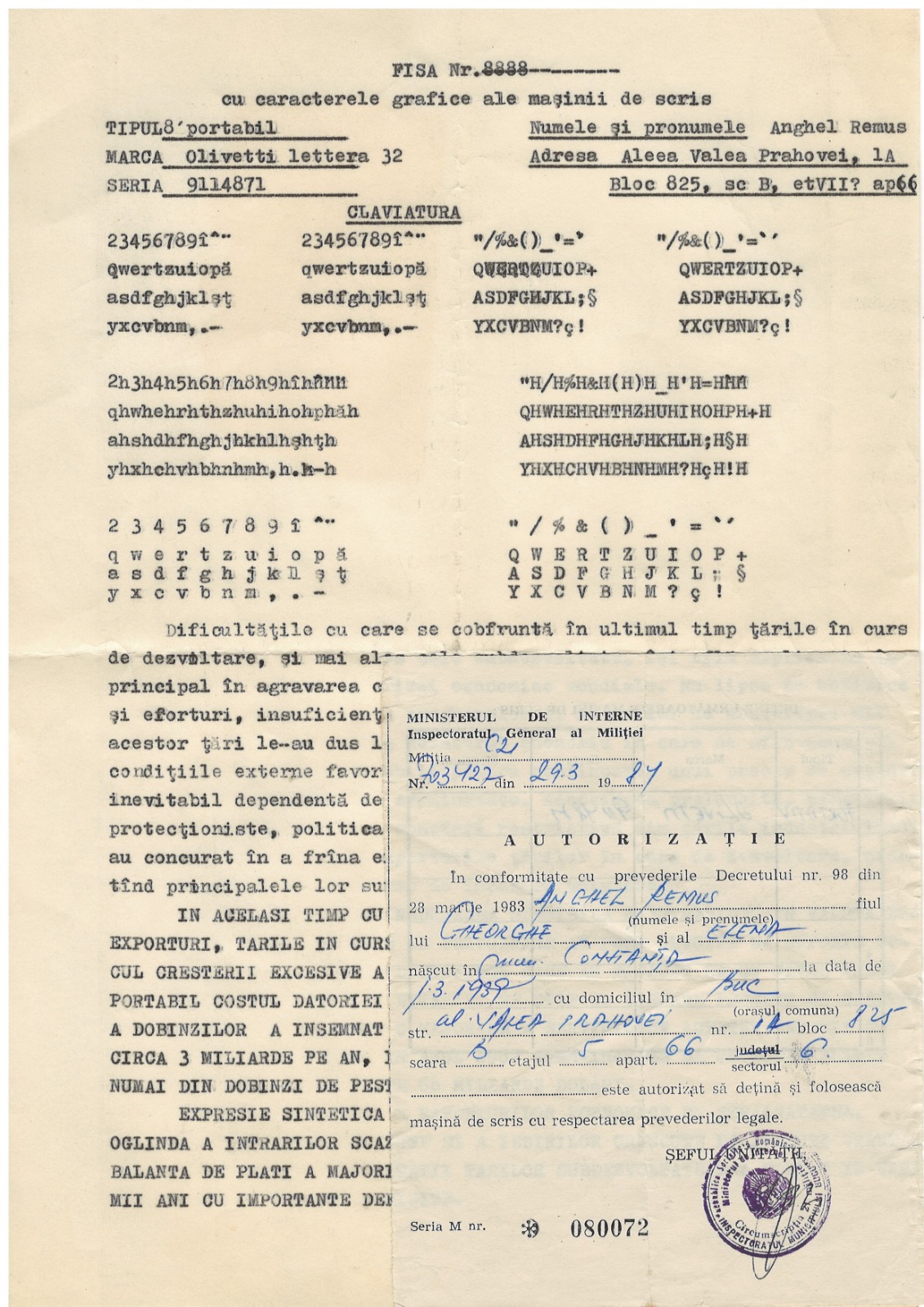
“I found something amongst the old papers!” was the only warning I got before my father started drowning me with the ghosts of his past. This discovery of it, brings me to the starring item of this text however. You see, grandpa held a typewriter in his possession. You must understand, that was quite a big deal. And an Olivetti, no less. He was so very proud of it. You get this feeling, you know? That minor jolt of electricity passing through your fingers – the knowledge that so many great writers had written on a typewriter, one that you hold in your own possession and one you can’t say everyone does. He did need it for his work, actually. That was the reason he had it in the first place. He used to work for this newspaper, Romania. The destination: China. The treasure- trove: life and politics in Romania. Chinese he could never speak, but he did visit China once. When my father told me that, I added 1 with 1 in my head. It suddenly all made sense! All that Chinese china, the paintings and fans with horizontal and perpendicular stripes – hanzi lettering. And the cherry on top: my grandmother’s obsession with all things Chinese! But the communists were some scarred lot. They realised people could write protests by typewriter, thus wake up a sleeping dragon. So, to prevent the worst case scenario, they had samples of every typewriter: every letter it wrote, every symbol and every number. This, take it if you will, is the nature of the communism. The fear of people expressing their desire, using their rights for a better life. The truth is that it wasn’t all good then. My mother makes a habit of expanding on the less than pleasing details of the times under Ceaușescu. The way they used to stand from dawn to sunset at the queue, all to buy some bread and milk, the delight in eating an orange! But anybody speaking ill of Ceaușescu would be sent to prison. And oh, you want to express your rights? Good luck doing it behind bars! – Romania had been in debt and the only path the ruler saw to get out was starving the people.