
Grandmothers and Grandfathers: Grand Stories. Family Treasures.
About the Creator
Pavlo Atamanchuk (16), Ukraine
On November 27, 1944, during the Lviv–Sandomierz Operation, the city of Lviv was liberated by the troops of the 1st Ukrainian Front from German occupation, which had lasted since June 1941. Fierce battles for the city continued from July 24 to July 27. My great-grandfather, Ivan Mykolaiovych Bilan (born in 1914), was drafted into the Soviet Army in July 1944. He was an infantryman and fired a “Katyusha” rocket launcher.
Near Przemyśl in Poland, my great-grandfather Ivan and his fellow villager Vasyl Kochan fell into a German ambush and were taken prisoner. Through a kind man who knew German, they learned that at dawn civilians would be released, while soldiers would be taken further away. During the night, they took off their military uniforms and buried them so that at dawn they appeared to be civilians. They were released, while the German forces marched the soldiers away. My great- grandfather and his friend Vasyl returned home and later rejoined the army.
It was near Kraków. The company in which my great-grandfather Ivan served was returning from the front line, while another was heading there. Ivan recognized Hnat Zamiiskyi, who was going to the front. The commander ordered them to stop for a minute. The fellow villagers rushed toward each other and embraced: “Alive!” — “Alive!” — “Do they write from home?” — “They do!” — “Stay well!” They exchanged only a few words before the commander ordered them to move on. Fierce fighting was taking place. The company in which my great-grandfather served spent the
night in an old burned barn in the field. The next day the company went to the front line, while from the front they carried the wounded and the dead, frozen bodies, and laid them under the church.
They dug a large pit with a tractor and buried the fallen soldiers in a mass grave.
When four soldiers carried a mortar, they often changed positions because their hands became numb. My great-grandfather Ivan was in front. He had just changed places and moved to the back when those in front were shot. That is how he miraculously survived.
Ivan Bilan fought his way to Auschwitz, where on January 27, 1945, he was wounded in the chest. He saw a German soldier about 200 meters away aiming at him, but there was nowhere to hide. The bullet passed through his lung. It was severely cold, and the blood froze near the wound, which helped him survive. In the evening, medics arrived. Our side collected their wounded, and the Germans collected theirs. In a simple Polish barn converted into a hospital, he underwent surgery and was later sent by train to Ukraine. He was treated in Berdychiv for a year.
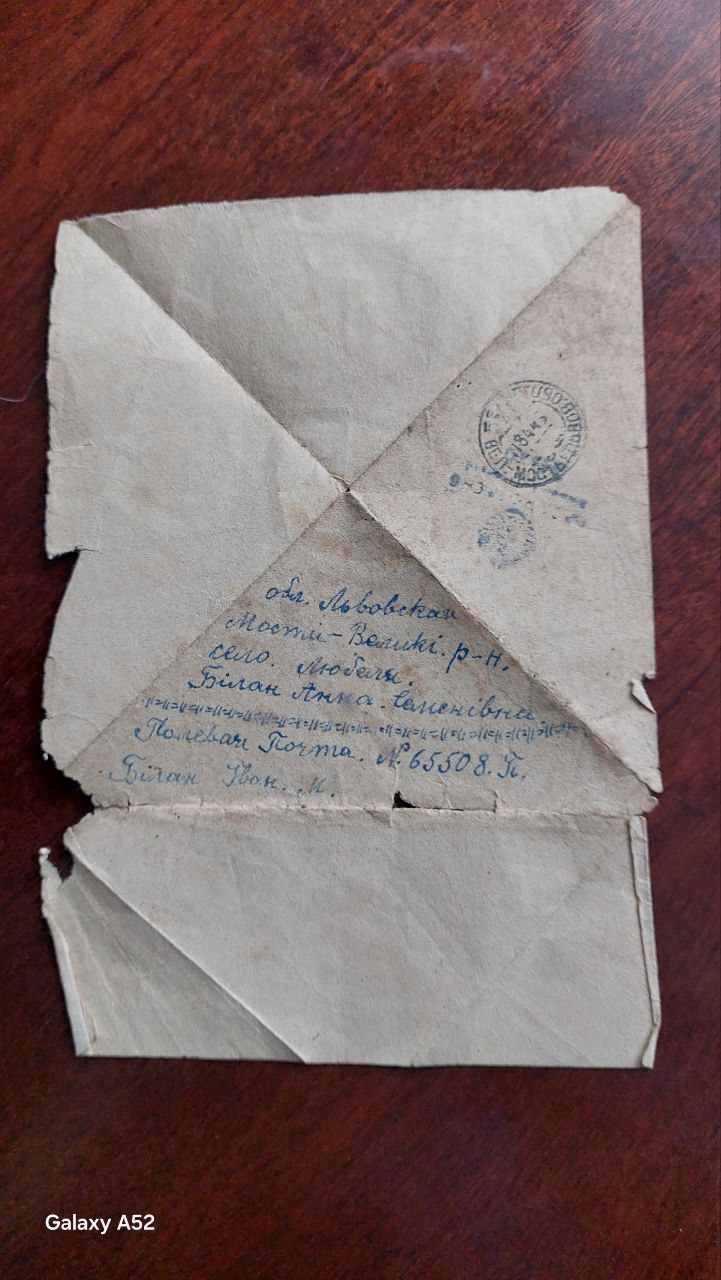
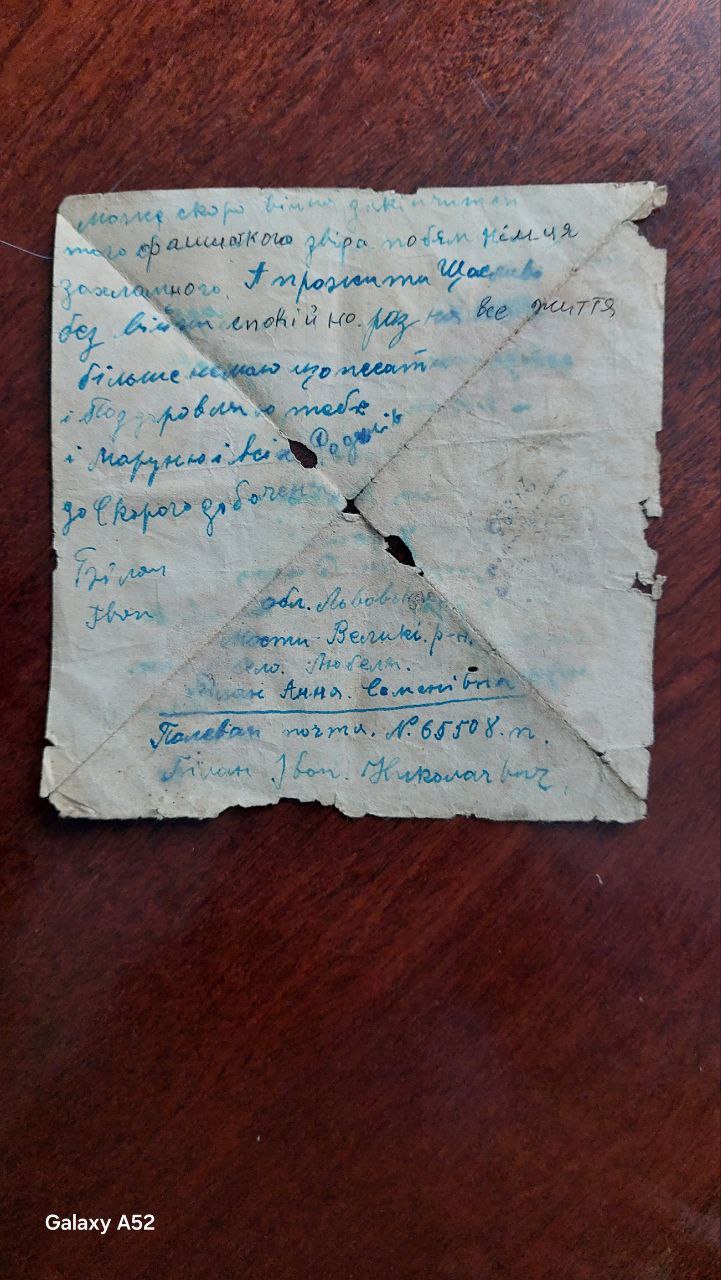
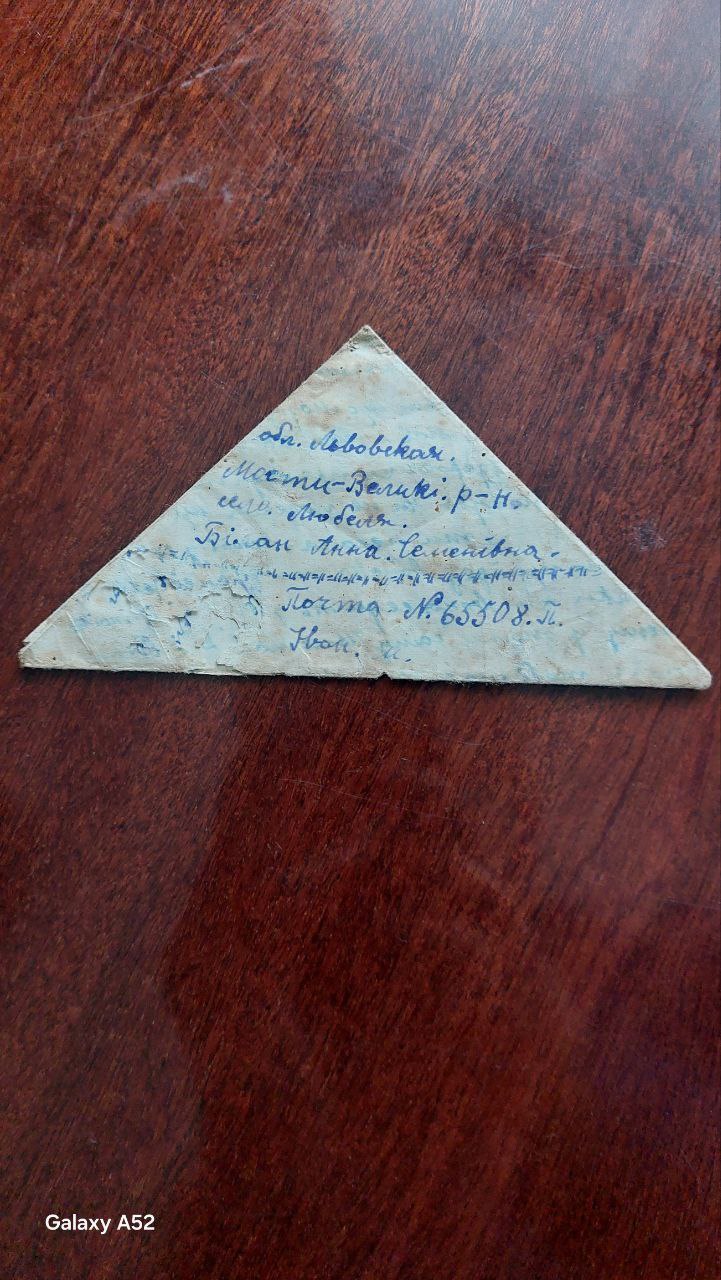
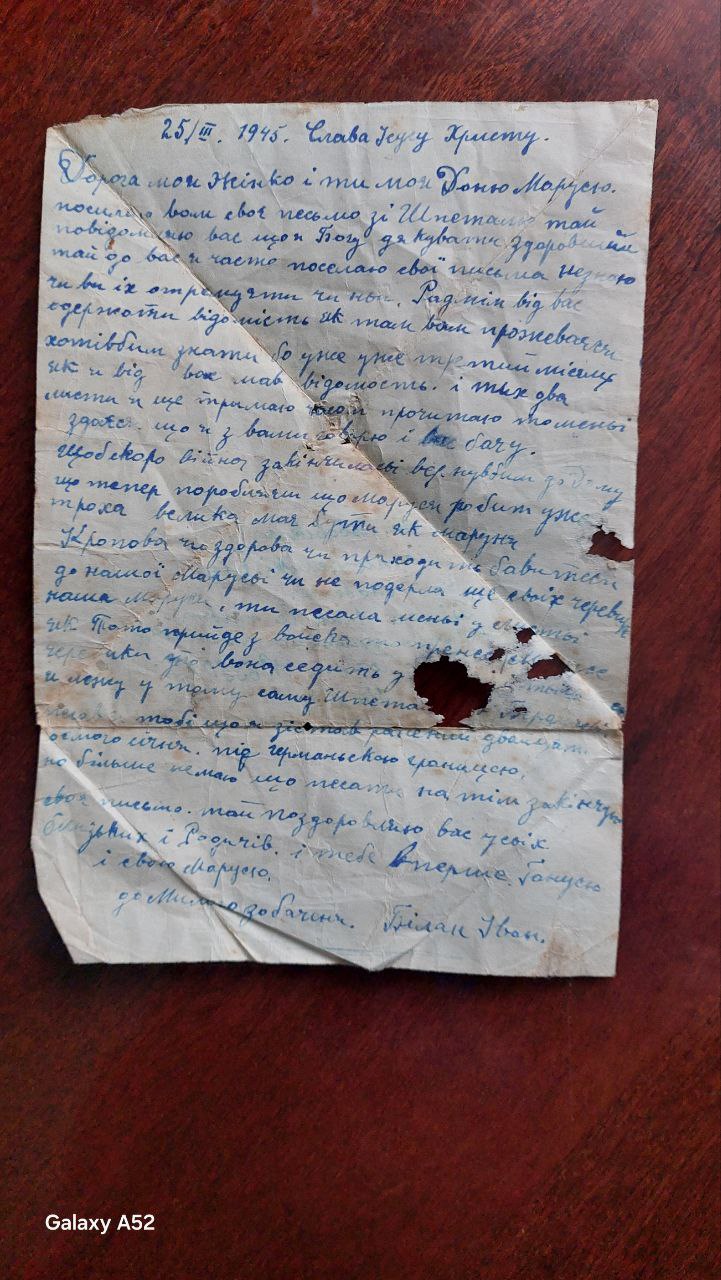
During the Great Patriotic War, soldiers wrote letters home through the Polish postal service. A sheet of paper was folded into a triangle. The address was written on the outside, and inside were the most precious things — words of love, faith, and hope. By folding the letter into a triangle, a soldier seemed to place a part of his heart inside it. This small paper triangle became a bridge between the front and home, between fear and hope. Such letters brought great joy to families. Several of these letters are still kept in our home as a family relic. In them, my great-grandfather writes that he is wounded and in the hospital. He is happy to be alive. He asks about the children, his wife, and his mother. He writes that he will return soon. It is a memory of brave and courageous people in whose hearts faith and hope lived even when war was raging all around.
There should never have been war again. But everything repeats itself, as if moving in a spiral. Once again there is a terrible war, even worse than the previous one.