A story at the kitchen table
About the Creator
I'm a Media Art student at the Academy of Fine Arts in Warsaw. I love taking pictures and travelling. My dream is to become a photojournalist one day.
This story travelled through memory, whispered from my great - grandma to my grandma, and from her to me. It is a story of faith, resilience, and the unbroken human spirit - a story of ordinary people caught in the extraordinary currents of history. Begins like every other story that time.
It begins with a girl named Pola.
Childhood in Kamień Pomorski
Pola was sixteen when her childhood ended. She lived in Kamień Pomorski, a small village surrounded by fields, forests, and the gentle winds of the Baltic. Her house was always alive: nine siblings ran through the house, full of laughter, shouting, and chaos. Pola was the middle child, neither the oldest nor the youngest, yet responsibility had already nestled in her bones.
From an early age, she worked as a maid in neighbouring homes. She scrubbed floors until her knees ached, swept hearths, carried water, and took care of the children. Her hands, small and delicate once, had become calloused and strong. Responsibility came early in that era, especially to girls.
Then, the war came.
Forced labour and departure
The German occupation did not spare anyone. People were deported for forced labour. Villagers whispered grimly that one person from each family had to go. Her brothers had fled into the forest, joining partisan groups. Her sisters were either too young or already married. Pola was sixteen. Neither married nor a child. She was old enough to be taken.
In 1941, she was sent to a parachute factory south of Berlin, in the Teltow area. Factories there were central to German aviation, producing parachutes for the Luftwaffe and Fallschirmjäger - the paratroopers whose jumps often determined the fates of battles.
The Teltow region, dense with industrial complexes like the Arado Flugzeugwerke and electronics firms such as Ringstorff, buzzed constantly with work. It was a place where human bodies and machines merged into a single, exhausting rhythm.
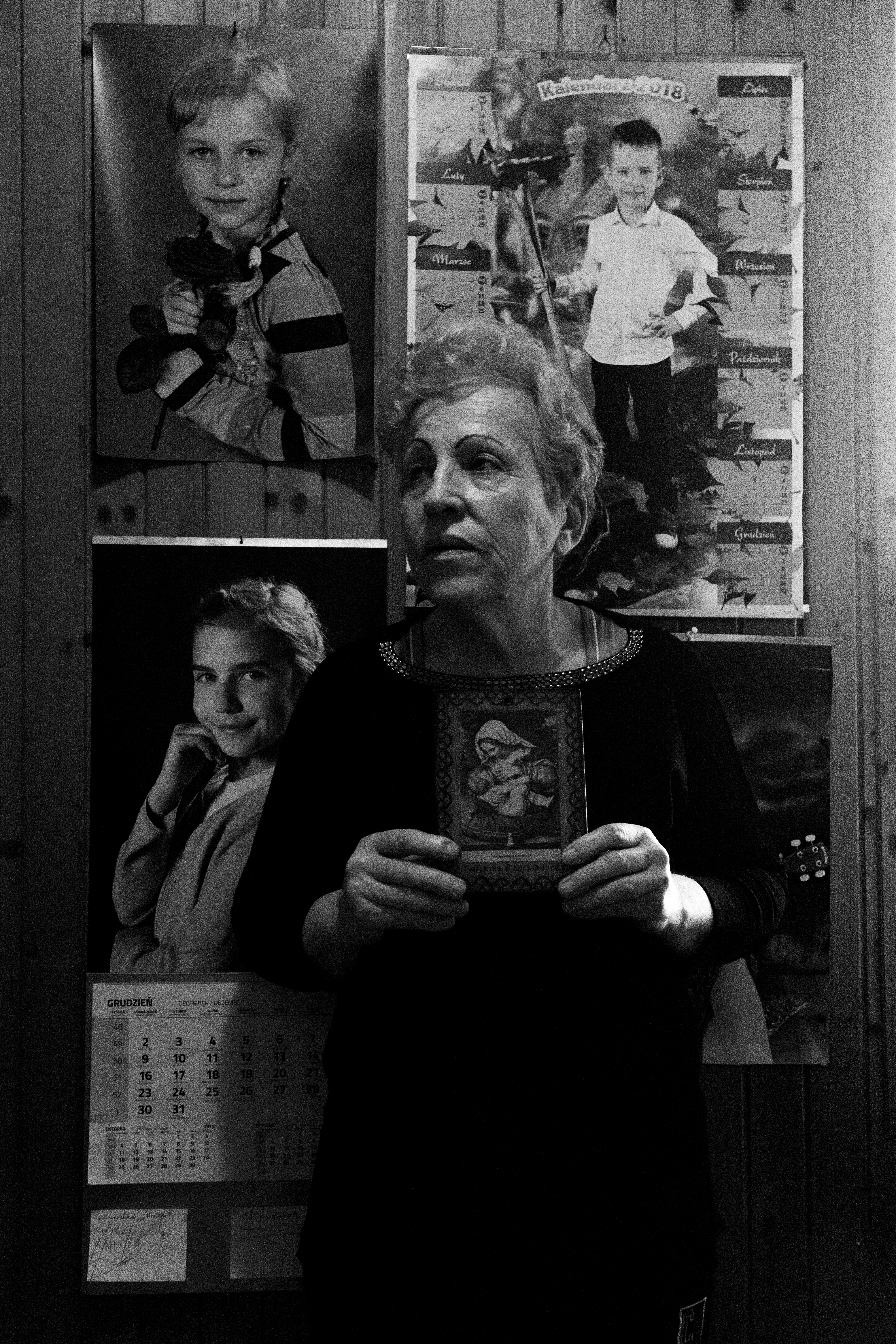
As she was leaving, her cousin pressed a small painting into her hands: the Virgin Mary feeding Jesus.
“Take this,” she said. “It will protect you.”
Pola held it close, not out of superstition but out of hope. She did not know then how desperately she would cling to it, or how it would shape her survival in the years to come.
The factory of shadows
Life at the factory was relentless. She worked twenty hours a day, often standing on the concrete floor, weaving parachutes, stitching harnesses, assembling canopy parts.
By the mid-1940s, silk had become scarce, and rayon replaced it. The machines screamed and rattled, their rhythm unceasing. Every day was a repetition: the same motions, the same hours, the same deafening hum of industry.
Food was almost non-existent. I asked my grandma if they were given anything - like maybe a bowl of soup, a loaf of bread. She looked at me with pleading eyes.
“No, sweetheart,” she whispered. “The only food they gave them was rotten potatoes and swede.”
At what might have been called lunchtime, German officers would impale potatoes on their knives and toss them into the crowd. People would jump and scramble, clashing elbows, desperate for a single morsel. Pola, driven by hunger, once lunged closer than anyone dared. She reached—but instead of a potato, she caught the officer’s knife. The thin line of scar it left on her palm remained a lifelong reminder of desperation, survival, and sheer luck. Hunger followed her like a shadow. Once she saw a loaf of bread in the window of a “casino” - a shop, as my grandma later explained, not a gambling hall (as I thought). She stood in line, heart pounding, waiting for her chance.
When the moment came, she slipped the bread under her coat. A German officer noticed, and Pola thought she would die in this moment. Yet somehow, she survived. The officer pretended like he didn’t notice. Hunger had made her fearless. She understood the price of life and food in a way few others ever would.
Faith in the midst of fire
Faith, Pola believed, kept her alive. She prayed daily, quietly, earnestly, even amid the chaos of the factory, the screams of machinery, and the bombings that began in 1945. Berlin had become a city of smoke and steel, and the Teltow factories were targets.
On April 16, Soviet forces launched their final offensive. Two fronts attacked from the east and south, a third from the north. By April 20, Hitler’s birthday, artillery tore through the city centre. Over the next week, the Red Army advanced street by street, and Berlin fell.
A bomb struck the factory where Pola worked. She pressed herself against a wall. Shrapnel whistled past her. She survived. And she believed, without question, that it was the painting of Mary and Jesus that had saved her. Faith, she would say, was the anchor that kept her from sinking in the storm.
A friend on the journey
In the factory, she met a girl, Maria. They became best friends, leaning on each other in the bleakest hours. After the war, Maria decided to return to Warsaw, and Pola, having nowhere else to go, chose to follow. They walked for three days to reach the nearest train station, somewhere near Poznań.
On the train, an impossible coincidence occurred: she heard a familiar voice calling her name. It was Paszkowski, a neighbour from her hometown. He asked with incredulity:
„Polcia, is that you?”. Both could hardly believe it. In a world without phones, without social media, in a city scarred and broken, she had found someone she knew. What a relief it was for her to find out that her family was safe and sound in the outskirts of Lublin.
But the world was not yet safe. A Red Army soldier, or “sołdat,” declared she would be his wife. Pola exited the train to go to the toilet, and the soldier became agitated, firing his pistol. She hurried back aboard, heart racing, and Paszkowski hid her under his coat.
He instructed her to leave at the sixth station. She stepped onto the platform barefoot, dirty, wearing a white dress, the weight of exhaustion pressing down on her.
She was walking through the village. Then she saw it: a big tree, hills, and a cow tied to the tree. A woman was milking it, holding two full buckets. The figure moved toward her. Pola was approaching closer and closer. In front of her it was a woman. A woman that she knew. Pola ran into her arms, and buckets slipped from her grasp, spilling milk onto the ground. It was her mother. Relief and joy surged through her. My grandma told me later that Pola’s mom didn’t recognised her after those years of war. She was so exhausted. But the taste of homemade pierogi with cheese the next day was something Pola never forgot.
Rebuilding a Life
After the war, the family claimed a house previously owned by magnates who had perished. Pola’s brother, Janek, joined the Polish United Workers' Party (PZPR). Though the rest of the family disagreed with the party’s ideology. They said:
„partia robotników, przyjaciele bolszewików”. But this connection brought tangible benefits: animals, furniture, land. Janek and his siblings - Stacha, Piotr, Janka, Adam, and Michał - built their houses nearby. They shared resources, borrowed cows, and tools, and worked together to cultivate the land. They were helping and supporting each other’s a lot.
Tolek’s side of the history
By then, Pola was thirty two. Her brother told her she could not work for him forever. He went to another village to find a horse - and returned with Tolek. He was five years younger, shy, peculiar, yet not disabled - a crucial trait after the war! They did not fall in love at first sight. Tolek had only three days (as a trial) before he had to return home. As his father died, he was the „head” of the house. Pola’s family, very Slavic in their hospitality, welcomed him with vodka and warmth.
Formality dissolved. Slowly, something steady emerged: understanding, companionship, and mutual respect.
A week later, they were married. They slaughtered a pig and celebrated their wedding in the village firehouse. Their life began not with romance, but with shared labour, faith, and survival. That’s how it worked in that times.
Building a Home
At the start, they lived in the attic of Pola’s brother’s house - no water, no toilet. Determined, they built their own home, despite ridicule from villagers who laughed at her. Pola raised children and grandchildren there, a testament to resilience and strength.
She remained deeply religious. Many of the people she knew had perished from typhus or tuberculosis, yet she survived them all. She believed the God and the painting of Mary and Jesus had protected her. My grandma called her “the rocket” for her positive energy. She did everything faster, better, and more fiercely than anyone else. She was always unstoppable.
Legacy
Pola passed away when I was eleven. I don’t remember her fully, yet I remember her warmth and her hidden sweets in the drawer for me and my cousins. I believe her genes, her energy, her courage, flow through me. I want to be unstoppable and brave like her. I will always admire her, even though we didn’t spend so much time together.
PS.
My grandma told me that when they were living in the old house, she had wanted to throw the painting away because it hung on the kitchen wall and didn’t match anything. That’s when Pola got furious - and it was then that the whole story came to light.
I love listening to the stories in the kitchen. No matter if it’s a party and I’m sitting on the flor or it’s my grandma’s place and I’m eating lunch she prepared. I think the greatest stories always start there.
Photos